REJUVA SOLE™
Rise Above the Ache™
Rise Above the Ache™
Affiliate disclosure: As an Amazon Associate, I earn from qualifying purchases. If you buy through a link on this page, I may earn a commission at no additional cost to you. Affiliate availability and commission never determine my conclusions. You can read my full affiliate disclosure.
How this review was created: I have not personally tested the Orthofeet Coral. I based this review on current manufacturer details, the shoe’s design, and the practical questions I ask as someone living with neuropathy, chronic pain, and mobility limitations. If I have not worn a shoe myself, I will tell you plainly.
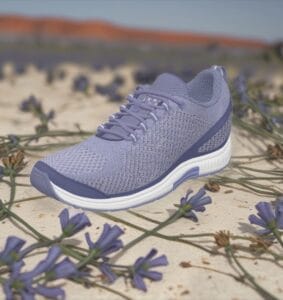
My short take: The Coral is worth a look if you want a forgiving knit upper, a smooth interior, and room to fine-tune the fit. Its strongest case is giving sensitive feet more breathing room—not providing firm motion control. That tradeoff matters: the cushioning and 15.7 mm heel-to-toe drop may make walking feel easier for one person but too soft, too elevated, or less predictable for someone with major balance concerns.
| Feature | What Orthofeet currently lists | Why it matters |
|---|---|---|
| Upper | Stretchable, water-repellent synthetic knit | The knit may give around bumps or mild swelling better than a rigid upper. Water-repellent does not mean waterproof. |
| Widths | Varies by color and current stock. White currently shows B, D, and 2E; Gray shows A, B, D, 2E, and 4E. | Coral has broad width coverage overall, but not every width is offered in every color or size. Check the exact configuration before ordering. |
| Weight | 9.7 oz for women’s size 7 medium | Relatively light on paper, though weight changes by size and width. |
| Heel-to-toe drop | 15.7 mm | The heel sits noticeably higher than the forefoot. Some readers may like that; others may prefer a flatter-feeling shoe. |
| Fit tools | Arch Booster and removable fitting spacers included | They let you fine-tune support and interior room, but more arch support is not automatically better. |
| Intended use | Walking, standing, casual outings, lifestyle, and errands | Best viewed as an everyday comfort walker, not a firm motion-control or technical athletic shoe. |
One thing the original Rejuva Sole review got right is that the Coral is built to give sensitive feet more room. I still agree with that. But extra space and less rubbing do not automatically make any shoe the right choice for every painful foot, especially when circulation, skin, or sensation problems raise the stakes.
The knit has some give around bunions, hammertoes, and mild swelling instead of pressing like a stiff overlay. That can be a welcome change when one sore spot keeps rubbing. The tradeoff is structure: a very flexible upper may not hold the foot as firmly as a more built-up walking shoe, especially when turning or moving side to side.
Orthofeet calls the knit water-repellent. I would treat that as limited protection from light moisture, not permission to use the Coral as a rain shoe.
Orthofeet’s current Coral pages do not show one universal width range. The White configuration lists medium (B), wide (D), and extra-wide (2E), while Gray currently runs from narrow (A) through XX-wide (4E). Other colors and individual sizes may differ. That is broad choice overall, but the label still cannot tell you toe-box height, total room, or whether the widest part of the shoe lines up with your foot. Judge the actual fit—not just the word “wide.”
Orthofeet describes the Coral as having a pressure-free fit and seam-free interior. Fewer raised seams may lower one source of friction, which is a sensible feature for sensitive skin. It cannot guarantee that the shoe will be pressure-free on your foot. The tongue, collar, insole edge, sock, lacing tension, or a small object inside the shoe can still create a problem.
The included Arch Booster adds support beneath the insole, while removable spacers can take up extra room or help reduce heel movement. This is more useful than a one-setting-only shoe. It also means the first setup may not be the best setup. Try the shoe with and without the optional pieces, one change at a time, and pay attention to pressure under the arch and heel security.
If you use a custom orthotic, try your actual device in the exact size and width you plan to keep. “Orthotic-friendly” does not guarantee enough depth or a secure heel for every insert.
Orthofeet’s Ortho-Cushion system is designed to soften impact and help the foot roll forward. That may feel kinder than a hard, flat shoe. Still, cushioning is not the same as stability, and the listed 15.7 mm drop is substantial. If you prefer a flatter shoe, do not adjust easily to heel height, or feel unsteady on soft soles, take that seriously.
The stretch upper and smooth interior are sensible features when rubbing is a concern. They do not make the Coral a treatment for neuropathy or diabetes, and they do not replace professional foot care. When sensation is reduced, it is easy to miss a blister or sore spot. The National Institute of Diabetes and Digestive and Kidney Diseases recommends checking the inside of shoes and inspecting feet every day. Rejuva Sole’s neuropathy footwear guide explains more of the fit and safety questions I use.
A forgiving knit may squeeze less than a hard toe cap or stiff forefoot overlay. The range of width choices is useful, but remember that availability changes by color and size. There is also a fit tradeoff: going wider at the front can leave too much room at the heel. The included spacers may help, but a sliding heel is a reason to try another size or model—not something to ignore.
Swelling can change during the day, so try shoes when your feet are usually largest and make sure the laces do not bite into the top of the foot. If swelling is sudden, painful, hot, red, or only on one side, that is a reason to contact a healthcare professional—not just buy a roomier shoe.
Soft cushioning and an easier roll forward may feel good when hard landings or stiff shoes aggravate pain. On the other hand, a softer sole can ask more of your balance, and the higher heel may change how your ankles, knees, or hips feel. Comfort during the first minute is not enough; walk, turn, stop, and stand before deciding.
The removable fit pieces make the Coral more adaptable than many ordinary sneakers, but I would not call it universally AFO-friendly. The opening, depth, heel hold, and thickness of your brace all matter. Try the actual brace rather than relying on the shoe’s width label, and involve the clinician who fitted it if the brace affects your walking or balance.
The listed 9.7-ounce weight may feel less tiring than a heavy orthopedic walker. The tradeoff is that the stretch upper, cushioning, and 15.7 mm drop may not feel predictable to everyone. Test short steps, turns, backing up, and standing from a chair near a stable support. If the heel slips, the sole feels wobbly, or your toes grip to keep the shoe on, it is not a good match.
For a broader checklist, see how to choose therapeutic shoes for comfort and foot conditions.
Orthofeet currently labels the Coral “true to size,” but that is a manufacturer fit summary, not a guarantee. Foot volume, swelling, bunions, socks, and orthotics can all change the size or width that works.
There is no single width range across every current Coral configuration. The White page currently lists medium (B), wide (D), and extra-wide (2E), while Gray runs from narrow (A) through XX-wide (4E). Other colors, sizes, and stock may differ, so check the exact combination you want before buying.
Its stretch upper, smooth interior, and width choices may suit some sensitive feet. It does not treat neuropathy or diabetes, and it is not automatically the right shoe if you have ulcers, circulation problems, major loss of sensation, foot deformity, or prescribed footwear needs. Ask a qualified clinician about those concerns.
The adjustable interior and removable fit components make an orthotic trial reasonable. Whether it works depends on the orthotic’s thickness and shape, available depth, and heel hold. Test your own device before keeping the shoe.
No. Orthofeet also lists a Coral No-Tie option, but the standard Coral and no-tie version should not be treated as interchangeable. Confirm the closure shown on the exact product page.
No. Tammy researched the Coral and evaluated its features through the lens of her own neuropathy, pain, balance concerns, swelling, and mobility limitations. Rejuva Sole never claims hands-on use when a shoe has not been personally tested.
The Coral has a clear purpose: make an everyday walking shoe more forgiving and adjustable. I like the stretch knit, smooth interior, broad overall width coverage, fitting spacers, and optional extra arch support. Those are practical features, not empty decoration.
I am glad the original review noticed the Coral’s useful comfort features, but I would not bring back its near-perfect score or call it a first choice for everyone with nerve pain. I have not personally tested it, and no shoe can honestly earn that certainty across neuropathy, diabetes, arthritis, bunions, swelling, orthotics, and balance needs. My more useful verdict is this: compare the Coral when extra room, adjustability, and cushioning matter most, but look elsewhere when you need firm control, a flatter ride, hands-free entry, unusual brace volume, or prescribed diabetic footwear.
I am not a physician, nurse, podiatrist, or other medical professional. Rejuva Sole provides educational information based on lived experience and product research. It is not medical advice, diagnosis, or treatment. Ask a qualified healthcare professional about symptoms, fall risk, circulation problems, braces, orthotics, or footwear needs specific to you.