REJUVA SOLE™
Rise Above the Ache™
Rise Above the Ache™
Research-based FitVille EasyTop Wings V2 review covering 2E–6E width, swelling, neuropathy, easy closure, stability, fit cautions, and honest tradeoffs.
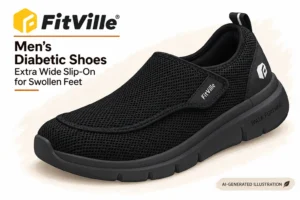
My honest take: The FitVille EasyTop Wings V2 is one of the more practical choices I have researched for men who need a very wide opening, room for swelling, widths through 6E, and an adjustable closure that is easier to manage than laces. Its smooth interior, roomy toe box, padded collar, removable insole, and rigid rubber outsole all deserve attention. The tradeoff is that this is a bulky, high-volume comfort shoe—not a lightweight athletic shoe or a true corrective motion-control model.
How this review was created: I have not personally worn the EasyTop Wings V2. This is an independent, research-based review built from current manufacturer specifications, construction details, the FitVille size guide, brand-hosted customer feedback, and the real-life needs I consider as someone living with severe neuropathy, chronic pain, balance limitations, and mobility challenges.
Affiliate disclosure: Rejuva Sole participates in affiliate programs, including Amazon Associates. If you buy through a qualifying link on this page, I may earn a commission at no additional cost to you. Affiliate availability never determines my conclusions.
FitVille currently lists the men’s EasyTop Wings V2 in Wide 2E, Extra Wide 4E, and XX-Wide 6E. That is unusually generous width coverage. The upper opens broadly and closes with two adjustable hook-and-loop flaps, giving swollen feet and high insteps more entry room than a standard lace-up shoe.
But a bigger shoe is not automatically a safer shoe. Extra space helps only when the heel and midfoot still feel secure. If your heel lifts, your foot slides forward, or the outsole catches because the shoe is too long or too voluminous, try a different size or model. Measure both feet while standing, use the current FitVille chart, and fit the larger foot. If your swelling changes through the day, test the shoe at the time your feet are normally largest.
The upper combines breathable mesh with polyurethane material intended to add structure. FitVille describes a seamless interior, a padded collar, and a silky lining. Those details are promising for sensitive skin because raised seams and stiff edges can become pressure points when sensation is reduced.
The wide-open adjustable closure is the standout feature. It should be much easier to reach and fasten than traditional laces, especially for people with arthritis, hand weakness, or limited bending. It also allows more adjustment when one foot is more swollen than the other. Still, inspect where the flaps overlap. A strap that is pulled too tight can create pressure across a high instep even when the toe box feels roomy.
FitVille lists a high-density rebound insole and a dual-density EVA midsole. That combination is intended to balance cushioning with support rather than create an extremely soft, marshmallow-like ride. The insole is removable, which may help if you use an orthotic, but replacing it can change the available depth and the way the heel sits in the shoe.
The company lists an approximate weight of 325 grams for one US men’s size 8.5 shoe. That is not exceptionally heavy for a substantial comfort shoe, but weight changes by size and width. Anyone with drop foot, leg weakness, or a shuffling gait should judge whether the shoe feels manageable—not just whether it feels comfortable while sitting.
The EasyTop Wings V2 uses a U-shaped heel cup and a rigid rubber outsole with a patterned bottom. These features may give the shoe a more planted feel and better surface grip than a soft house slipper. The broad footprint may also feel reassuring for some wide-footed walkers.
I would not call it a maximum-stability or motion-control shoe. FitVille does not publish the kind of independent torsional, heel-counter, or lab-based stability measurements that would justify that claim. For major balance problems, severe overpronation, or a history of falls, the correct test is whether your foot stays centered and the shoe moves predictably with your gait.
For neuropathy, I like the design on paper: substantial width choices, a spacious toe box, a smoother interior, padding around the collar, an adjustable opening, and a removable insole. Those features may reduce rubbing or pressure when the size is right. They do not make the shoe risk-free, and the word “diabetic” in marketing is not a promise that it is right for every person with diabetes or neuropathy.
The CDC recommends daily foot checks for people with diabetes-related nerve damage and advises checking inside shoes for objects and rough areas. That is especially important during a new-shoe trial. Remove the shoes after short indoor sessions and look for redness, blisters, warm spots, or pressure marks—even if you do not feel pain.
This is where the EasyTop Wings V2 makes its strongest case. FitVille’s own customer-review section repeatedly mentions edema, wrapped feet, and the need for a larger opening. The brand currently labels the shoe “AFO & Brace Friendly,” but that is a manufacturer description, not proof that every brace will fit. AFO shape, footplate length, ankle bulk, and heel position vary too much for a blanket guarantee.
If you use a brace, bring the exact brace and socks into the trial. Confirm that the heel reaches the back, the straps close without excessive tension, the toes have clearance, and the outsole remains level. Sudden, severe, painful, or one-sided swelling needs medical attention rather than a roomier-shoe workaround.
At the time of this review, FitVille displayed 488 reviews for the men’s EasyTop Wings V2, with 78% rated five stars and 8% rated one star. Visible comments frequently praised the broad opening, room for edema or wraps, easy on-and-off design, and comfort. That is useful real-world context, but it is hosted on the manufacturer’s website and should not be treated as independent testing.
The design itself points to the most likely tradeoffs: it may feel too roomy for a narrow heel, bulkier than an athletic sneaker, and less corrective than a dedicated motion-control walking shoe. Long-term outsole durability and midsole compression will also depend on body weight, gait, walking surface, and frequency of wear.
The FitVille EasyTop Wings V2 fills a real gap. Many men do not simply need a “wide” shoe—they need depth, an opening large enough for swelling or wraps, and a closure they can actually manage. This shoe addresses those needs better than many ordinary walking sneakers.
My verdict is promising for wide, swollen, sensitive, or hard-to-fit feet, with important fit and balance cautions. I would shortlist it for neuropathy when a smooth interior and pressure-free fit are priorities. I would not make it the automatic choice for severe overpronation, significant fall risk, or any situation where a clinician has prescribed a specific type of protective footwear.
Verify the current FitVille specifications and size guide before ordering. Product details, inventory, and return terms can change.
No. This is a research-based review. I clearly separate manufacturer claims, customer reports, design-based assessment, and firsthand testing.
Its roomy widths, adjustable opening, padded collar, and smoother interior make it worth considering, but only a careful fit test can show whether it protects your particular foot from rubbing and pressure. Reduced sensation makes daily skin checks essential.
FitVille markets the model as AFO- and brace-friendly, and the insole is removable. Compatibility depends on the exact device and whether the heel remains seated securely after insertion. Test the complete setup indoors.
I am not a physician, nurse, podiatrist, or other medical professional. Rejuva Sole provides educational footwear information based on lived experience and careful product research. Shoes do not diagnose, treat, or cure neuropathy, diabetes, edema, arthritis, balance disorders, or another medical condition. Contact a qualified healthcare professional about wounds, circulation problems, sudden swelling, major loss of sensation, repeated falls, braces, or footwear prescribed for your specific needs.