Brooks Ghost Max 4 Review: A Real-World Test for Very Wide Feet, Bunions and Joint Pain
One wearer’s four-day Ghost Max 4 experience, verified shoe facts, fit cautions and a comparison with the Brooks Adrenaline GTS 25.
Finding a shoe is fairly straightforward when one thing hurts.
It becomes much harder when several problems overlap.
We recently helped an adult woman who had been extremely difficult to fit comfortably. She weighs more than 300 pounds and has thick, very wide feet, overpronation, plantar fasciitis, large painful bunions, knock-kneed alignment accompanied by severe knee pain, and recurring right hip pain.
She had also discovered two things through repeated trial and error:
Shoes with a large heel rise tended to aggravate her pain.
And extremely soft, “marshmallow-like” cushioning did not necessarily make her feel better. In some shoes, it made her feel worse.
Several pairs were tried.
Several pairs were returned.
Finally, we decided to spend more and try the men’s Brooks Ghost Max 4, using men’s sizing to get the width and overall volume her feet needed.
The Real-World Experience
The Ghost Max 4 arrived after a particularly bad day.
She came home from work with throbbing feet. Her plantar fasciitis was bothering her, her bunions hurt, and she was limping because of significant knee and right hip pain.
I handed her the Brooks.
Her first reaction had nothing to do with cushioning, stability or biomechanics.
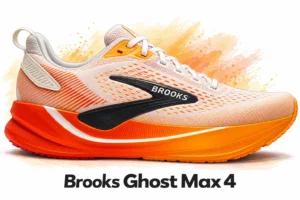
She liked the color.
That actually mattered.
After trying shoe after shoe that either hurt, did not fit, or looked like something she did not want to wear, she finally had a pair she was happy to put on.
When she first tried them, she noticed they felt more snug than her current shoes.
Because her feet were already hurting so badly that evening, she could not tell whether that snugness would become a problem.
So we did not judge the shoe from a few minutes indoors.
She wore them to work the next day.
After One Full Workday
The Ghost Max 4 still felt a little more snug than her previous shoes.
But something important did not happen.
Her bunions did not hurt.
By the end of the day, most of the pain she had experienced the night before was gone.
She reported:
- Zero bunion pain
- Zero knee pain
- Zero hip pain
For her, that was remarkable.
She said it was the first time in approximately a year that she had finished a day without the usual knee and hip pain.
That is one person’s experience. It does not mean the Ghost Max 4 will eliminate pain for everyone with bunions, plantar fasciitis, overpronation, knee pain or hip pain.
But it told us something very important about her footwear needs.
Day Four: The Better Test
Then came a much tougher test.
By the fourth day, she had worked, taken her children to multiple Halloween events, walked considerably more than usual, and spent several hours standing.
The bunion, knee and hip pain still had not returned.
And there was an unexpected bonus.
Several people stopped her to compliment the shoes.
After all the boxes, returns and shoes that did not work, the pair that finally stayed on her feet was also the pair strangers kept noticing.
We will take that victory.
One Detail We Almost Overlooked: Heel-to-Toe Drop
This experience reinforced something I think people often overlook when shopping for shoes.
Heel-to-toe drop is the difference in height between the heel and the forefoot inside the shoe.
The Brooks Ghost Max 4 has a 6 mm heel-to-toe drop.
This wearer had consistently struggled with shoes that placed her heel substantially higher than her forefoot.
For her, the lower 6 mm difference appears to have worked much better.
That does not mean lower is always better.
Some people function better with a higher-drop shoe. Others prefer less difference between heel and forefoot. Medical conditions, walking mechanics, ankle mobility, Achilles problems and personal comfort can all change what feels best.
The lesson is simpler:
Do not choose shoes by cushioning alone. Pay attention to how high the heel sits compared with the forefoot. Higher or lower can make a huge difference.
Brooks Ghost Max 4: The Shoe Facts
Now that we have talked about the real-world experience, here is what Brooks actually built into the shoe.
Heel-to-Toe Drop
6 mm
This is one of the specifications that caught our attention after seeing how differently this wearer responded to the shoe.
Weight
The men’s Ghost Max 4 weighs approximately:
10.3 oz / 292 g
Cushioning
Brooks classifies the Ghost Max 4 as a highly cushioned shoe with balanced cushioning.
That distinction matters.
This wearer had previously disliked shoes that felt extremely soft and unstable underfoot. The Ghost Max 4 still provides substantial cushioning, but her experience was very different from the overly mushy shoes she had rejected.
Rocker-Assisted Transition
The Ghost Max 4 uses rocker geometry designed to help move the foot from landing through toe-off.
That may make walking feel smoother for some people.
However, rocker-style shoes are not automatically appropriate for everyone.
Our plantar fasciitis shoe-selection guide explains other fit and support factors to consider.
People with significant balance impairment, foot drop or difficulty controlling forward movement should evaluate rocker footwear carefully.
Broad, Stable-Feeling Platform
Brooks describes the Ghost Max 4 as providing a stable feel for more confident steps.
That is particularly relevant because a shoe can have a lot of cushioning without necessarily feeling stable.
Accommodating Fit
Brooks describes the fit as accommodating and specifically notes additional room for orthotics.
For our wearer, using the men’s version gave us access to the width and overall shoe volume that had repeatedly been difficult to find in women’s shoes.
For more on width and depth, see our swelling, bariatric and wide-feet footwear guide.
Brooks Ghost Max 4 vs. Brooks Adrenaline GTS 25
These two Brooks shoes can both work well for walking, but they take very different approaches.
Brooks Ghost Max 4
- Heel-to-toe drop
- 6 mm
- Men’s weight
- 10.3 oz / 292 g
- Support approach
- Broad stable-feeling platform with rocker-assisted transition
- Cushioning
- High, balanced cushioning
- Motion guidance
- Rocker helps transition from landing to toe-off
- Walking
- Yes
- Orthotics
- Brooks specifically lists orthotics as a best use
- Best reason to consider it
- Lower 6 mm drop, substantial cushioning, broad platform
- Potential concern
- High stack and rocker may not suit some people with balance problems
Brooks Adrenaline GTS 25
- Heel-to-toe drop
- 10 mm
- Men’s weight
- 10.6 oz / 300.5 g
- Support approach
- Structured support using GuideRails
- Cushioning
- Balanced soft and dynamic cushioning
- Motion guidance
- GuideRails helps keep excess movement in check
- Walking
- Yes
- Orthotics
- Fit should be evaluated with the individual orthotic
- Best reason to consider it
- More structured guidance for excess movement
- Potential concern
- 10 mm drop may not suit someone sensitive to heel elevation
Manufacturer specifications checked October 27, 2026. Sources: Brooks Ghost Max 4 and Brooks Adrenaline GTS 25. Weight varies with shoe size. Fit observations and cautions are Rejuva Sole’s assessment.
What About Overpronation?
This is where the comparison becomes interesting.
The Adrenaline GTS 25 would be the obvious Brooks model to consider if structured support for excessive movement were the main priority.
Its GuideRails system is specifically designed to help keep excess movement in check.
Our wearer does overpronate.
So on paper, the Adrenaline GTS 25 made sense.
But people do not walk on paper.
The Adrenaline GTS 25 has a 10 mm heel-to-toe drop.
The Ghost Max 4 has a 6 mm drop.
Because this wearer had repeatedly experienced discomfort with greater heel elevation, the Ghost Max 4 turned out to be the better real-world match for her despite not using the Adrenaline’s GuideRails system.
That does not make the Ghost Max 4 the better shoe.
It makes it the better shoe for this particular person.
That distinction is one of the most important ideas behind Rejuva Sole.
Read our full Brooks Adrenaline GTS 25 review for its fit and support tradeoffs.
What We Liked
- 6 mm heel-to-toe drop
- Broad, stable-feeling platform
- Substantial cushioning without feeling excessively mushy to this wearer
- Accommodating fit
- Room for orthotics
- Rocker-assisted heel-to-toe transition
- Men’s sizing helped accommodate an unusually thick, wide foot
- No bunion rubbing reported during this real-world trial
- Remained comfortable through work and several hours of standing
- Attractive enough that strangers actually stopped to compliment the color
What We Would Watch Carefully
- The shoe is still high-stack despite its relatively low 6 mm drop
- Rocker geometry will not suit everyone
- It does not provide GuideRails structured support like the Adrenaline GTS 25
- Very large bunions still require careful sizing and fit evaluation
- A snug shoe should never automatically be assumed to “stretch out”
- People with substantial balance problems or foot drop should approach high-stack rocker shoes carefully
- Someone who needs strong structured guidance for overpronation may prefer a different model
Best For
The Ghost Max 4 may be worth considering for someone looking for:
- A lower heel-to-toe drop than many traditional walking shoes
- Substantial cushioning
- A broad, stable-feeling base
- Long periods of walking or standing
- Space for orthotics
- Wider men’s sizing options
- Cushioning without an excessively soft sensation
Use Caution or Consider Another Shoe If
The Ghost Max 4 may not be the best starting point if you:
- Need substantial structured motion control
- Have significant balance impairment
- Have foot drop
- Feel unstable in high-stack shoes
- Do poorly with rocker-style soles
- Need a very firm, traditional walking platform
The Rejuva Sole Takeaway
This experience reinforced one of the reasons Rejuva Sole exists.
You cannot choose the right shoe from one marketing word.
Cushioned.
Supportive.
Wide.
Stability.
Good for walking.
None of those tells the whole story.
This wearer had very wide feet, bunions, overpronation, plantar fasciitis, knee pain and hip pain.
A shoe that addressed one problem could easily aggravate another.
For her, the combination of fit, cushioning, platform stability and a 6 mm heel-to-toe drop appears to have worked considerably better than the shoes she had previously tried.
After four demanding days, including work, walking and hours of Halloween activities:
The shoes stayed on.
The bunions stayed quiet.
The knee stayed quiet.
The hip stayed quiet.
And apparently the orange shoes developed their own fan club.
After everything it took to find them, these were the shoes that did not go back in the box.
Explore the Men’s Brooks Ghost Max 4
Affiliate link: Rejuva Sole may earn a commission from qualifying purchases.

Brooks Men's Ghost Max 4 Running Shoes
Price, sizes, widths, colors and availability can change. Confirm your fit and the retailer’s return policy before buying.
Educational Disclaimer
This review describes one individual’s real-world footwear experience and is provided for educational purposes only. Individual footwear needs vary. Shoes are not a treatment for medical conditions, and improvement experienced by one wearer does not predict another person’s results. People with persistent foot, joint, balance or mobility problems should discuss appropriate footwear with a qualified healthcare professional.
Affiliate Disclosure
Rejuva Sole may earn a commission from qualifying purchases made through some retailer links. Commissions do not determine which shoes we recommend, criticize or exclude.