REJUVA SOLE™
Rise Above the Ache™
Rise Above the Ache™
Affiliate disclosure: Rejuva Sole may earn a commission if you buy through a qualifying link on this page, at no additional cost to you. Affiliate relationships never decide whether I recommend a shoe.
How this review was created: This is a research-based review. I did not personally test the Brooks Ghost Max 3. I compared current manufacturer specifications with independent testing where available and evaluated the shoe through Rejuva Sole’s Stable Anchor Footwear principles. Specifications and availability were last checked August 30, 2026.
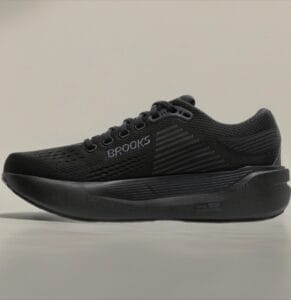
The Brooks Ghost Max 3 stands out because it combines a broad base, a high stack of DNA LOFT v3 cushioning, and a GlideRoll™ Rocker. Brooks positions it for walking, everyday running, and orthotics. Those are useful qualities for some people with plantar-fasciitis heel pain, but they do not make the shoe a treatment or an automatic match.
The honest distinction is that this is a stable-feeling neutral shoe, not a motion-control shoe. Its width comes from the platform and its smooth transition comes from the rocker. A person who feels secure on that geometry may appreciate it. Someone who shuffles, catches the toe, dislikes rocker shoes, or needs stronger pronation control may not.
| Current specification | What it means in real life |
|---|---|
| Use | Neutral road-running and walking shoe; Brooks also lists it for orthotics. |
| Cushioning | High-stack DNA LOFT v3 cushioning with a soft, protective emphasis. |
| Transition | GlideRoll™ Rocker assists movement from landing to toe-off. |
| Drop | 6 mm according to Brooks. |
| Weight | Women’s 10.0 oz / 283.5 g; men’s 11.2 oz / 317.5 g. |
| Women’s widths | Medium B, Wide D, and Extra Wide 2E; stock varies. |
| Men’s widths | Medium D, Wide 2E, and Extra Wide 4E; stock varies. |
| Support | Broad neutral base for inherent stability; no GuideRails or medial-post correction. |
| Recognition | Brooks lists the APMA Seal of Acceptance. |
Brooks had already introduced the Ghost Max 4 when these specifications were checked, and the Ghost Max 3 page showed discounted, uneven stock. Treat price and width availability as changeable rather than permanent.
The Brooks Ghost Max 3 may be a weaker choice if you:
Plantar-fasciitis shoppers are often told to chase the softest possible shoe. That is too simple. Cushioning can soften impact, but comfort also depends on heel security, arch compatibility, toe room, and whether the platform feels predictable. The Ghost Max 3 earns consideration because it combines cushioning with a broad footprint instead of balancing a tall stack on a narrow base.
Its rocker is both a feature and a tradeoff. It may reduce how much the forefoot has to bend during a step and make walking feel smoother. It can also feel unfamiliar or less controllable to a person with a shuffle gait, weak ankle control, or rocker sensitivity.
Brooks says the broad base provides inherent stability without interfering with a neutral stride. Independent reviews also describe the Ghost Max 3 as stable for a tall neutral shoe.
That does not equal structured stability. If your foot collapses inward substantially or your ankle needs firm side-to-side control, the flat footprint may not be enough.
The high stack of nitrogen-infused DNA LOFT v3 foam is designed to reduce pressure underfoot and create a soft, smooth ride. That may feel welcome when hard floors aggravate the heel.
More foam also raises the foot farther from the ground. The shoe is not extremely light, and a tall platform can feel bulky during quick turns or short, hesitant steps.
The 6 mm drop and curved rocker are designed to move the shoe from landing toward toe-off. For someone with a comfortable heel-to-toe gait, that assisted roll may reduce the sense of fighting a stiff forefoot.
A rocker cannot guarantee safer walking. Test starts, stops, turns, and side steps near a stable support. If the shoe pulls you forward, delays your reaction, or catches during a shuffle, it is the wrong geometry for you.
Three width categories are useful, especially the men’s 4E and women’s 2E options. A wider label can reduce side pressure if the last matches your foot.
Width is not the same as extra depth or an anatomical toe shape. Check bunions, toe height, heel slip, and swelling in the exact size and width you intend to keep.
Brooks lists orthotics among the Ghost Max 3’s best uses. A removable stock insole and neutral geometry can make it easier to add a prescribed device without stacking correction on top of a stability system.
Compatibility still depends on thickness and shape. A bulky insert may lift the heel, crowd the toes, or change how the rocker feels. An AFO usually needs more depth than a conventional running shoe provides.
AAOS notes that supportive shoes with thicker soles and cushioning may reduce pain during standing and walking for some people with plantar fasciitis. The Ghost Max 3 fits that general description, and the broad base may keep its cushioning from feeling excessively narrow.
The arch is not customized to your foot, the rocker is not universally comfortable, and footwear is only one part of care. Persistent or severe heel pain deserves evaluation rather than endless shoe experiments.
Multiple widths and a cushioned platform may suit some people with mild neuropathy, but this is not a diabetic therapeutic shoe. Inspect the interior, wear appropriate socks, and check skin after a short indoor trial. NIDDK explains that reduced sensation can hide rubbing, blisters, and debris.
The broad base may feel steady for a neutral walker. The high stack and rocker may feel unsafe for a shuffler or someone who has difficulty clearing the toe. A brace user must test the exact brace and should not assume an Extra Wide label provides AFO depth.
Protective cushioning and an assisted transition may feel easier on hard surfaces, but the 6 mm drop and rocker change movement up the chain. Comfort at the heel does not guarantee comfort at the knee, hip, or back.
I am not giving the Ghost Max 3 a numeric score because this is a research-based review without a documented scoring system or Tammy wear test.
My honest verdict is conditional: it is a strong shoe to compare for a neutral walker who wants protective cushioning, a broad base, and room for a compatible orthotic. It may also suit some people with plantar-fasciitis heel pain who feel better in a gently rockered shoe.
It is a weaker choice for a person who shuffles, dislikes rockers, needs strong pronation control, requires extra-depth therapeutic footwear, or feels less stable when standing high off the ground.
At Rejuva Sole, I do not simply recommend popular shoes or repeat a manufacturer’s pain-relief promise.
I evaluate every model using the same Stable Anchor Footwear principles: a steady base, secure heel support, enough room for the toes, controlled cushioning, realistic orthotic compatibility, and comfort that does not ignore balance or mobility. This review clearly separates manufacturer specifications from independent findings and does not claim personal testing that did not happen.
My goal is simple: educate first and recommend second. The right shoe is not the one with the strongest advertising. It is the one that fits your actual feet and helps you move as comfortably and confidently as your circumstances allow.
No. This review is based on current Brooks specifications, independent testing, and Rejuva Sole’s established footwear criteria. It does not claim firsthand wear experience.
It is a stable-feeling neutral shoe with a broad base. It does not use Brooks GuideRails or a traditional medial post, so it should not be described as a corrective stability shoe.
It may feel comfortable for some people because it combines cushioning, a broad base, and an assisted rocker transition. It does not treat plantar fasciitis, and people who dislike rockers or need a different arch shape may prefer another shoe.
Brooks lists orthotics as a best use. Test your exact device because thickness can lift the heel, crowd the toes, and change the rocker.
Brooks lists women’s B, D, and 2E and men’s D, 2E, and 4E. Exact sizes and colors were unevenly stocked when checked.
Not automatically. A broad base can help the shoe feel steady, but a high stack and rocker may be difficult for a shuffler or someone with poor toe clearance. Test only in a safe setting and seek professional advice when fall risk is significant.
Rejuva Sole provides educational footwear information, not medical advice, diagnosis, treatment, or a guarantee of pain relief or fall prevention. Footwear may support comfort, but the 2023 heel-pain clinical practice guideline does not treat an orthosis as a stand-alone short-term solution. Stop using a shoe that causes pain, numbness, skin irritation, new pressure, or instability, and ask a qualified healthcare professional about persistent heel pain, circulation problems, ulcers, fall risk, braces, orthotics, or prescribed footwear.