REJUVA SOLE™
Rise Above the Ache™
Rise Above the Ache™
Affiliate disclosure: As an Amazon Associate, I earn from qualifying purchases. If you buy through a link on this page, I may earn a commission at no additional cost to you. Affiliate relationships do not change my conclusions.
How this review was created: I have not personally tested this model. This is my independent, research-based review after spending hours comparing manufacturer and retailer information, design features, sizing and width details, and the practical needs of Rejuva Sole readers.
My short take: The Brooks Addiction Walker 2 is worth comparing if your priorities include structured support, walking stability, fit and durability. It is not a medical device, fit is individual, and I would only keep it after a careful indoor trial.
Important limitation: A motion-control walking shoe cannot treat neuropathy, and its firm structure may not be comfortable or appropriate for every gait.
Research verdict: A structured-support walking shoe with useful width choices and important weight, firmness, and fit tradeoffs.
Worth comparing for: Structured walking support • Firm underfoot feel • Leather durability • Multiple width options • Careful indoor fit trials
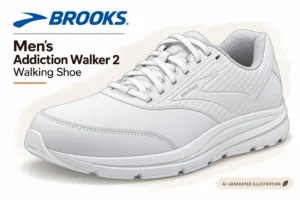
The Brooks Addiction Walker 2 is a structured walking shoe that Brooks currently describes as offering maximum support, balanced cushioning, and a durable leather upper. That design may feel predictable to some walkers, but it can also feel firm and heavy.
If structured support is your priority, this shoe may deserve a careful comparison—provided its weight, firmness, width, and heel hold suit your foot and gait.
Stability can matter, but the most supportive-looking shoe is not automatically the safest or most comfortable choice for every person.
Brooks uses an Extended Progressive Diagonal Rollbar (PDRB) to guide motion through the stride. That is a design feature, not proof that the shoe will correct alignment or reduce pain for a particular person.
A firm platform may feel more predictable to some readers. Others may find the shoe too rigid, heavy, warm, or difficult to adapt to, especially when sensation, strength, or balance is changing.
✔ Extended Progressive Diagonal Rollbar® (PDRB) structured-support system
✔ Wide, stable outsole
✔ Rubber outsole; traction still depends on the surface, tread condition, and your gait
✔ Full-grain leather upper
✔ Durable BioMoGo DNA cushioning
✔ Contoured support that may feel firm or prominent
✔ Available in multiple widths
✔ APMA Seal of Acceptance
✅ Structured, firm-feeling support platform
✅ Designed to guide excess motion; individual gait needs still matter
✅ Firm construction may feel predictable, but the shoe cannot prevent falls
✅ Durable construction
✅ May suit longer standing or walking when the fit and firmness feel right
✅ Available in Wide and Extra Wide
✅ Multiple widths may help with fit; age alone does not determine suitability
❌ Heavier than most athletic walking shoes
❌ Leather upper is less breathable than mesh
❌ Conservative styling may not appeal to everyone
The Brooks Addiction Walker 2 may be worth comparing if you:
• Prefer a firm, structured walking platform
• Can monitor skin, pressure, and temperature carefully during short indoor trials
• Want balanced cushioning rather than a very soft, sink-in feel
• Need several width choices and can check heel and toe room carefully
• Have been advised to compare motion-control or structured-support footwear
• Can safely test the shoe’s weight, turning feel, and heel hold near stable support
• Prefer a design intended to guide excess inward motion
• Want a durable leather walking shoe for daily errands or standing
• Can manage the laces, firm upper, and heavier construction
• Will confirm prescribed therapeutic-footwear requirements with a clinician and qualified supplier
This shoe may not be ideal if you:
• Prefer an ultra-soft, cloud-like feel
• Need a lightweight running shoe
• Want maximum flexibility
• Spend most of your time exercising rather than walking
Brooks classifies the Addiction Walker 2 as a maximum-support walking shoe.
Its firm platform may feel steady to some people, but stability is personal and cannot be guaranteed from specifications alone.
Brooks describes the cushioning as balanced rather than ultra-soft.
That may suit someone who dislikes a sink-in feel, while another person may find it too firm.
The men’s model is currently listed at 14.5 oz and the women’s at 12.9 oz, with a 12 mm drop. Those numbers make an indoor walking trial especially important.
Value depends on fit, durability, return options, and whether the structured design matches your needs.
A higher price does not guarantee a better fit. Compare the current price, seller, return terms, and how the shoe performs during a careful indoor trial.
These are two of my favorite structured walking-shoe designs. They share leather uppers, motion-control features, rubber outsoles, and a substantial feel—but their fit choices differ. This is a comparison, not a promise that either shoe will fit you, relieve pain, or prevent a fall.
My short comparison: Start with the 928v3 if a men’s 6E width, hook-and-loop access, or a removable footbed is central to your search. Start with the Addiction Walker 2 if you want to compare Brooks’ PDRB approach and balanced, structured platform. Try either shoe indoors while returns are available; neither is automatically better.
Read my complete New Balance 928v3 review. Current specifications checked August 27, 2026 using the Shop Brooks Addiction Walker 2 through Rejuva Sole: men’s or women’s (affiliate links) and the official New Balance listing (manufacturer information reviewed; shopping link removed).
Based on my research, the Brooks Addiction Walker 2 is worth comparing for structured support, multiple widths, and a durable leather build—but it is not an automatic recommendation.
It isn’t flashy, and it isn’t designed to follow the latest fashion trends.
Its design focuses on structured support and balanced cushioning. Whether that produces comfort or confidence depends on your fit, gait, strength, sensation, and tolerance for a firmer, heavier shoe.
Readers managing pain, neuropathy, diabetes, or balance concerns should treat the shoe as one option to test—not as treatment, fall prevention, or a universally dependable solution.
Research status: Not personally wear-tested. Current specifications were checked against Brooks on August 27, 2026.
Rejuva Sole recommendation: Compare carefully and keep it only if the fit, pressure, weight, and walking feel work for you.
Rise Above the Ache™
I reviewed the features described for the Brooks Addiction Walker 2 with the questions that matter most to me as someone living with neuropathy, chronic pain, and mobility limitations: Is the base likely to feel predictable? Is the heel secure? Are there useful width or closure options? Could the cushioning or geometry create a tradeoff for balance? Product details and availability can change, so verify the exact model, size, and return policy before buying.
No. This review is based on my independent product research and my experience evaluating footwear features for people with pain, neuropathy, balance concerns, swelling, and mobility limitations. I do not claim hands-on use when I have not personally tested a shoe.
No. Shoes may affect comfort, fit, or stability, but they do not diagnose, cure, or treat medical conditions. Persistent pain, numbness, swelling, skin changes, or fall risk should be discussed with a qualified healthcare professional.
Try it indoors on a clean surface while the return window is open. Check toe room, heel movement, pressure points, traction, and stability for more than a few minutes. If you use an orthotic or brace, test it with the shoe rather than relying on a width label alone.
Based on my research, the Brooks Addiction Walker 2 deserves consideration for shoppers focused on structured support, walking stability, fit and durability. I would not call it universally “best,” and I would not promise medical relief. The honest decision comes down to whether its design matches your foot shape, gait, support needs, and ability to return it if the fit is wrong.
Try new shoes indoors while the return window is open. Stop if a shoe causes pain, numbness, skin irritation, new pressure, or a feeling of instability.
I am not a physician, nurse, podiatrist, or other medical professional. Rejuva Sole provides educational information based on my lived experience and hours of product research. It is not medical advice, diagnosis, or treatment. Ask a qualified healthcare professional about symptoms, fall risk, circulation problems, braces, orthotics, or footwear needs specific to you.
Affiliate reminder: I may earn a commission from qualifying purchases made through links on this page, at no additional cost to you. I do not let commissions determine what I say about a product.