REJUVA SOLE™
Rise Above the Ache™
Rise Above the Ache™
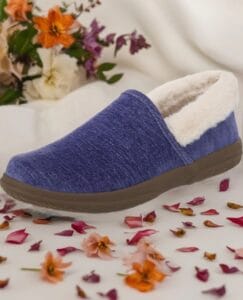
My short take: The Vionic Clare is a cozy, closed-heel slip-on with a removable contoured footbed and an indoor/outdoor outsole. It may suit someone who wants more arch structure than a flat house slipper, but its medium-width, non-adjustable fit will not work for every foot. The warm upper, prominent arch feel, and lack of a secure closure are important tradeoffs—not small print.
Testing disclosure: I have not personally tested the Vionic Clare slipper. This review is based on product research, current retailer information, Vionic’s description of its support technology, and my experience evaluating footwear features for readers living with pain and mobility limitations. I will not turn research into a pretend firsthand story.
Affiliate disclosure: As an Amazon Associate, I earn from qualifying purchases. If you buy through a link on this page, I may earn a commission at no additional cost to you. Affiliate relationships do not change my conclusions. You can read my full affiliate disclosure.
When you live with chronic pain, taking off your supportive shoes should not mean settling for a flimsy slipper that makes you feel less steady. That was the useful heart of my original Clare review, and it is still worth saying. The honest part is that “supportive” is not universal: a contoured footbed can feel reassuring to one person and far too assertive to another.
Support does not have to end when you walk through your front door. The Clare’s appeal is that it combines a soft-looking slipper upper with a more structured footbed than the thin foam found in many house shoes. Its slip-on shape also avoids laces and buckles.
Still, this is not a hands-free shoe with a reinforced step-in heel, and it is not a medical device. You must be able to guide your foot through the collar, and the shoe must hold your heel without pinching it. If bending is your main barrier, my Orthofeet Kita hands-free shoe review explains a very different kind of step-in design.
I could not confirm the Clare on Vionic’s current U.S. product catalog when I checked. Current specialty-retailer and marketplace listings still showed the model, so I would treat it as a retailer-stock or legacy style rather than assume every color and size is still being produced. Check the exact SKU, seller, return terms, and stock before ordering.
| Specification | What I could verify |
|---|---|
| Model | Women’s Vionic Clare cozy collar slip-on slipper |
| Upper and lining | Fabric/velvet upper, faux-shearling collar detail, and textile lining |
| Footbed | Removable microfiber-wrapped EVA footbed with Vio Motion technology |
| Outsole | Textured TPR/rubber outsole described for indoor and outdoor use |
| Closure | Slip-on; no adjustable strap or laces |
| Width | Medium only on the current exact-model retailer listings I found |
| Sizes | One current specialty retailer displayed women’s 5, 6–10 with half sizes in that span, 11, and 12; actual stock varied by color and size |
| Approximate dimensions | QVC lists a 1.13-inch heel and 0.83-inch sole |
| Weight and heel-to-toe drop | I could not independently verify model-specific figures |
| Slip resistance | A textured outsole is listed, but I found no model-specific occupational slip-resistance certification; it is not slip-proof |
Vionic describes Vio Motion technology in general as combining contoured arch support, cushioning, a deep heel cup, and forefoot flexibility. That tells us what the design is trying to do. It does not prove how the Clare will feel on your foot or promise relief from heel, knee, hip, or back pain.
The original review described the Clare as soft without being sink-in soft. That distinction matters. Plush lining can feel cozy against the foot, while the EVA footbed underneath may feel considerably firmer and more shaped than a memory-foam slipper.
A more structured footbed may feel predictable on a hard kitchen floor and may resist collapsing as quickly as very soft foam. On the other hand, someone with a sensitive arch, a rigid foot, or a low tolerance for pressure may find the contour uncomfortable. Cushioning can soften impact, but it is not the same thing as lateral stability or secure heel hold.
The exact-model listings I found showed a women’s Medium width. QVC describes the Clare as true to size and suggests a short daily break-in period at first, but that is retailer guidance—not a fit guarantee. The warm lining, collar, sock thickness, instep height, and foot volume can all change how much usable room you feel.
This is where width and depth must stay separate. A medium label does not tell you whether the slipper has enough vertical room for swelling, a high instep, or an orthotic. Stock also varies by color and size. If you need a wide or extra-wide fit, do not count on the fabric simply stretching enough.
If swelling changes during the day, a fixed slip-on opening gives you no strap to loosen. For a slipper with a more adjustable upper and a different fit approach, compare my Orthofeet Charlotte slipper review. It is still essential to check your exact width, depth, and heel fit.
The Clare’s collared heel can offer more contact than an open-back mule, which may be welcome if you dislike shuffling to keep a slipper on. However, there is no adjustable closure. If the collar is loose, the heel can lift; if it is tight, it can rub or create pressure. A contoured footbed cannot compensate for a slipper that does not stay with your foot.
The textured outsole is meant for everyday indoor and limited outdoor use, such as a dry porch or a quick trip to the mailbox. I would not translate that into “safe on every surface.” Wet tile, loose rugs, uneven ground, stairs, and worn tread can still create problems. I also found no model-specific occupational slip-test certification.
If balance is a concern, test the Clare near a stable support on a clean indoor floor. Notice whether your heel lifts, the toe catches, or the arch pushes you to one side. A slipper can feel comfortable while sitting and behave very differently once you walk and turn.
The removable microfiber-wrapped EVA footbed is useful because it gives you the option to inspect the space underneath and try a different insert. It does not automatically make the Clare compatible with every custom orthotic.
A thicker device can raise the heel, crowd the collar, or reduce depth. A rigid orthotic can also change how the slipper flexes and how firmly the heel is held. Test the complete combination indoors. I found no reliable model-specific evidence that the Clare is designed for an AFO or bulky brace; the medium-width slip-on opening and non-adjustable upper may be limiting.
The velvet/fabric upper and faux-shearling collar are part of the Clare’s cozy appeal. They may also feel warm or hold moisture, especially with socks or in a heated home. If your feet run hot, the slipper may be less comfortable than an open or more breathable style.
Readers with neuropathy, diabetes, reduced sensation, fragile skin, or circulation concerns need more than a comforting product description. Check the inside for seams or debris, inspect your skin after short trials, and stop for redness, rubbing, heat, numbness, or pressure. The Clare cannot prevent a fall, treat neuropathy, or replace individualized medical advice.
No. Tammy has not personally tested the Vionic Clare slipper. This is a research-based review using current retailer information, Vionic’s description of its support technology, and Rejuva Sole’s practical footwear-evaluation standards.
I could not confirm the Clare on Vionic’s current U.S. product catalog when checked, although retailer and marketplace listings still showed stock. Treat availability as seller-, color-, size-, and SKU-specific rather than assuming the full range is still produced.
The current exact-model specialty-retailer listing I found displayed women’s sizes 5, 6–10 with half sizes in that span, 11, and 12, in Medium width. Stock varied by color and size, so check the exact remaining-stock SKU rather than treating that as a universal range.
The original microfiber-wrapped EVA footbed is removable, which may create room for another insert. Compatibility is not guaranteed: a custom orthotic can change depth, collar pressure, heel height, and stability, so test the complete setup indoors.
Its contoured footbed, collared heel, and rubber-style outsole may feel more structured than a flat open-back slipper. However, the Clare has no adjustable closure and cannot prevent falls. Heel lift, toe clearance, turning, flooring, and individual gait all matter.
Retailer specifications describe a textured rubber/TPR outsole for indoor and outdoor use. I would limit that to ordinary, dry surfaces unless your own trial supports more. It is not a rugged outdoor shoe, slip-proof, or verified as occupationally slip-resistant.
No footwear can promise to diagnose, cure, or treat those problems. A contoured footbed may change comfort or how load feels, but results depend on fit, gait, diagnosis, and the individual. Persistent or worsening symptoms deserve qualified medical guidance.
Manufacturer and retailer descriptions are useful for specifications, but they are not independent proof of pain relief, balance improvement, or a universally good fit.
The Vionic Clare deserves a careful look if you want a cozy slipper with more structure than flat foam. I like the practical combination on paper: a removable contoured footbed, collared heel, and indoor/outdoor outsole. I also would not call it universally “best.” Medium-only retailer listings, a fixed opening, a warm upper, and an arch that may feel prominent are real limitations.
From morning coffee to evening relaxation, the right house shoe should feel comfortable without making you work to keep it on. The Clare earns a place on the comparison list—not a medical promise and not a guaranteed recommendation. Let your indoor trial decide.
Try the slipper indoors on a clean surface while the seller’s return window is open. Check toe room, arch pressure, heel movement, warmth, rubbing, and stability for more than a few minutes. Stop if you notice pain, numbness, skin irritation, new pressure, or a feeling of instability.
I am not a physician, nurse, podiatrist, or other medical professional. Rejuva Sole provides educational information based on lived experience and product research. It is not medical advice, diagnosis, or treatment. Ask a qualified healthcare professional about symptoms, fall risk, circulation problems, braces, orthotics, or footwear needs specific to you.