REJUVA SOLE™
Rise Above the Ache™
Rise Above the Ache™
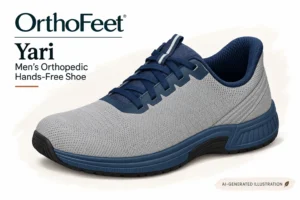
This Orthofeet Yari review takes a practical look at the men’s hands-free sneaker—where its roomy, cushioned design may help, where it may create tradeoffs, and what to verify before ordering.
Affiliate disclosure: As an Amazon Associate, I earn from qualifying purchases. If you buy through a link on this page, I may earn a commission at no additional cost to you. Affiliate relationships do not change my conclusions.
How this review was created: I have not personally tested the Orthofeet Yari. This review is based on current Orthofeet product information, retailer details, and my experience researching footwear features for people with neuropathy, chronic pain, swelling, and mobility limitations.
My short take: The men’s Orthofeet Yari is worth comparing if bending to tie shoes is difficult and you want a roomy, cushioned walking shoe. Its hands-free heel, stretch upper, removable insole, and configuration-dependent wide-width choices are practical advantages. The tradeoff is that convenient entry is not the same thing as locked-down heel control, the cushioning is not true motion control, and its 14.9 mm drop will not feel natural to everyone.
I would not call the Yari a universal “best shoe” for neuropathy, diabetes, or balance problems. Those are individual medical and fit questions. I would call it a thoughtful comfort shoe that deserves a careful indoor trial—especially if reduced sensation, swelling, an orthotic, or an AFO makes fit less predictable.
Those figures describe the men’s model. I have not transferred women’s specifications to this review, and I have not found an official stack-height measurement or an independent motion-control classification for the Yari.
If reaching your feet is painful, tiring, or simply not practical, a step-in heel can make getting dressed much easier. This is the Yari’s clearest advantage. You set the laces for your fit, then use the structured heel to step in without tying them each time.
That convenience may matter to someone living with arthritis, back or hip limitations, reduced hand dexterity, or limited mobility. It does not mean the shoe treats any of those conditions; it means the entry method may require less bending and hand work.
Orthofeet says its heel technology is designed to keep the shoe from slipping off, and the included spacers can help fine-tune interior volume. Still, heel hold depends on your foot shape, width, socks, gait, and how the laces are set. A loose heel can create rubbing; an overly tight setting can create pressure across the instep.
If you have reduced sensation, foot drop, or a history of falls, do not assume “hands-free” means safer. Try both shoes on a clean indoor surface, walk and turn, and pay attention to heel lift, toe catching, and whether the shoe feels predictable. An assistive device or brace can change all of that.
A 14.9 mm heel-to-toe drop is substantial compared with many walking and running shoes. Some readers may appreciate the heel elevation and rocker-inspired transition. Others—especially people used to low-drop shoes or a flatter, firmer platform—may feel pitched forward or simply uncomfortable. A high drop is not automatically good or bad, but it is a reason to test the Yari rather than ordering by brand reputation alone.
The stretch upper, wide toe-box shape, and multiple-width configurations are the useful parts of the original Yari review that deserved to be recovered. They may give bunions, hammertoes, swelling, or sensitive areas more breathing room than a stiff, tapered upper. But stretch does not replace correct sizing, and extra room can become unwanted movement if your heel or midfoot is narrow.
Width availability varies by color, size, configuration, and stock. I would not choose a color first and assume your width will be there. Start with the exact SKU that fits your foot, then decide whether the available color works for you.
Orthofeet describes its shoes as extra-depth and says its removable orthotic insoles are about 1/4 inch thick. The Yari also includes spacers and an Arch Booster, which gives you more ways to tune volume and arch feel. That makes it more orthotic-friendly than a shoe with a glued-in footbed, but it does not guarantee that every custom orthotic will fit without crowding the toes or lifting the heel.
I could not verify official AFO compatibility for this exact model. A brace adds bulk in places that a width label does not measure, and the hands-free heel may behave differently once a brace is inside. If you use an AFO, test the actual brace, sock, and shoe together and get professional fitting help when needed.
The original review was right to focus on cushioning, a smooth interior, and a removable insole. Those features can make a shoe feel more forgiving. The current Orthofeet page also describes multilayer cushioning, anatomical arch support, and a rocker-inspired sole.
However, a soft or rockered ride is not automatically stable for every gait. I found no independent evidence that the Yari is a maximum motion-control shoe, and Orthofeet does not publish a formal stability classification comparable with a running-shoe support category. If you need firm medial control, a very rigid base, or clinician-prescribed footwear, the Yari’s comfort-oriented design may not be enough.
The same gray area applies to its slip-resistant label. It is a helpful product feature, not a fall-prevention promise. Traction changes with the floor, contamination, tread wear, and the way you walk.
Neuropathy or diabetes: A smooth interior, extra room, and reduced friction may be useful design features, but they do not make the shoe risk-free or therapeutic. Reduced sensation makes daily skin checks and careful pressure-point testing more important, not less.
Bunions, hammertoes, or swelling: The stretch upper and toe room may feel more accommodating than a stiff overlay. Swelling can change during the day, though, and a setting that feels fine in the morning may not feel fine later.
Balance concerns or foot drop: The hands-free heel may simplify entry, but it does not prevent falls. Check heel hold, toe clearance, turns, and the feel of the 14.9 mm drop. If you use an AFO or have repeated falls, this is a good place for professional guidance rather than guesswork.
Orthotics: The removable insole and included fit aids are encouraging. Use your real orthotic during the return window and check that it does not raise your foot so high that the heel slips or the upper presses down.
If you are shopping for a women’s hands-free Orthofeet sneaker, my Orthofeet Kita hands-free review covers that separate model and its own configuration-dependent fit details. If you prefer a conventional lace-up design with a stretch-knit upper, compare my Orthofeet Coral review. Those are different shoes; their specifications should not be transferred to the men’s Yari.
The useful heart of the original review was its focus on a roomy toe box, stretch upper, smooth interior, cushioning, and removable insole. Those are still the right reasons to consider the Yari. I am less convinced by broad claims that make it sound like the answer for every painful or neurological foot condition.
For the right reader, hands-free entry may remove a frustrating daily obstacle, and the fit aids give you more room to fine-tune than many slip-ons. For another reader, the weight, high drop, soft/rockered feel, or heel fit may be the deal-breaker. My honest recommendation is to choose the exact width and configuration first, test it indoors with your usual socks and orthotic or brace, and keep it only if the heel stays secure and the platform feels predictable.
No. I have not personally tested the Orthofeet Yari. This review combines current manufacturer and retailer research with my experience evaluating footwear features for people with pain, neuropathy, swelling, balance concerns, and mobility limitations.
Width availability varies by color, size, configuration, and stock. When checked, the official Black/Gray page offered Medium (D), Wide (2E), X-Wide (4E), and XX-Wide (6E), while Black/Black offered Medium (D), Wide (2E), and X-Wide (4E). Verify the exact current SKU instead of treating either list as universal.
The removable insole, spacers, and Arch Booster make the Yari adaptable for many orthotic users, but fit still depends on the device and your foot. I could not verify official AFO compatibility for this exact model. Test your actual orthotic or brace in the shoe and check toe room, instep pressure, and heel hold.
Orthofeet describes anatomical arch support, multilayer cushioning, and a rocker-inspired sole, but it does not publish a formal maximum motion-control classification for the Yari. Cushioning and support may feel comfortable without providing the firm control a particular gait requires.
No shoe can guarantee fall prevention. Orthofeet labels the Yari slip-resistant, but traction varies with the surface, contamination, tread wear, and gait. Anyone with balance problems or repeated falls should test carefully and seek individualized guidance when appropriate.
Updated: August 21, 2026. Product pages, widths, colors, and stock can change; verify the exact configuration before ordering.
Try new shoes indoors while the return window is open. Stop if a shoe causes pain, numbness, skin irritation, new pressure, or a feeling of instability.
I am not a physician, nurse, podiatrist, or other medical professional. Rejuva Sole provides educational information based on lived experience and product research. It is not medical advice, diagnosis, or treatment. Ask a qualified healthcare professional about symptoms, fall risk, circulation problems, braces, orthotics, or footwear needs specific to you.