
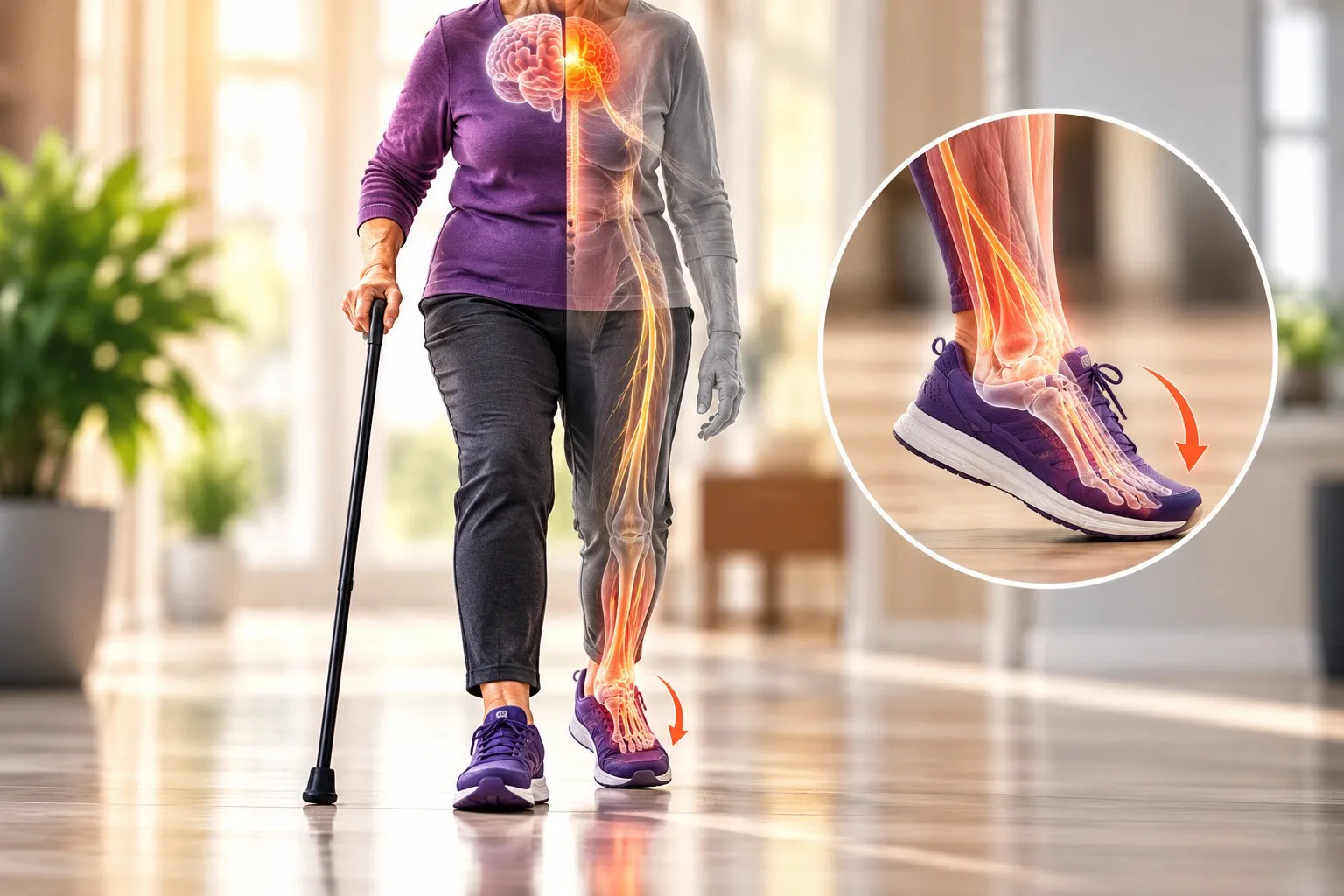
Understanding Stroke, Drop Foot and Balance
REJUVA SOLE™ · EDUCATIONAL GUIDE
After a stroke, choosing shoes can involve more than comfort. Weakness, altered sensation, difficulty lifting the toes, or trouble using one hand may change what you need. This guide explains walking changes, practical footwear checks, and when to ask your rehabilitation team for help.
Medical note: This information is educational, not a diagnosis or treatment plan. Shoes cannot cure foot drop, restore stroke-damaged brain tissue, replace rehabilitation, or guarantee that you will not fall.
Understanding stroke, foot drop, and balance
A stroke affects the brain. Its effects vary with the area and extent of injury. Foot drop describes difficulty lifting the front of the foot; it is a sign of a movement problem, rather than one single disease. Stroke is one possible cause. Peripheral nerve injuries and other neurological conditions can also cause it. The NHS explains foot drop and its possible causes.
Not every stroke survivor has foot drop, and not everyone with foot drop has had a stroke. New difficulty lifting the foot needs assessment rather than an assumption that an old diagnosis explains it.
A physical therapist can examine how you walk. An orthotist is a professional who fits braces. An occupational therapist can help with practical tasks such as putting on shoes with limited hand movement. The right combination depends on your needs.
How walking and balance may change
When the toes do not clear the floor, they can scuff or catch. Someone may lift a knee higher or change the path of the leg to get the foot through. Another person may take shorter steps. These examples are not a progression everyone follows; your pattern needs its own assessment.
Walking also depends on sensation, coordination, vision, strength, and balance. Fatigue can make a shopping trial different from an ordinary afternoon at home. Tell your therapist when problems happen: starting, turning, crossing a threshold, walking on carpet, or transferring from a wheelchair.
Footwear is only one part of managing trip hazards. The NHS also recommends appropriate walking aids, clear floors, good lighting, and removing loose rugs or cables. Keep using your prescribed mobility support while trying shoes.
Footwear features worth comparing
These are fitting considerations, not a clinically validated score or a promise that a feature prevents falls. Compare how the complete shoe works with your gait and any prescribed device.
Secure heel retention
Your heel should stay comfortably seated as you move. Repeated slipping, painful rubbing, or a collar that presses against a brace needs attention. A firm heel counter—the structure around the back of the shoe—does not compensate for the wrong size or shape.
A predictable platform and manageable cushioning
Consider whether the shoe feels steady during your usual standing and turning. More foam is not automatically better. Very soft, tall, or unfamiliar soles deserve a careful trial, especially when you already feel unsteady. You do not need to buy a particular category simply because its name includes “stability.”
Toe clearance, weight, and traction
Ask whether the front catches during your actual step and whether the shoe feels tiring to lift. There is no single safe shoe-weight cutoff for everyone. Compare grip on the surfaces you use; neither an aggressive tread nor a “slip-resistant” label guarantees suitable traction in every setting.
Adjustable closures you can use
Laces, hook-and-loop straps, or a wide opening may make fitting easier. Try fastening the shoe with your usual hand strength and assistance. Easy entry is useful only if you can also achieve a secure fit. A shoe that slips on conveniently but slips off during walking does not meet that need.
Checking an ankle-foot orthosis with the shoe
An ankle-foot orthosis, or AFO, is a brace supporting the ankle and foot. Designs differ: some help maintain foot position during the swing of a step, and others also address stability during standing. Your clinician chooses the device for your walking problem. Ordinary retail footwear does not provide equivalent treatment.
NICE stroke rehabilitation guidance recommends considering an AFO for selected walking difficulties, assessing the person’s ability to put it on, and checking comfort and ease of walking. That does not endorse any retail shoe or establish that every stroke survivor needs a brace.
- Bring the actual AFO, prescribed socks, and any required insert to the fitting.
- Check opening size, usable depth, closure reach, and whether the heel sits where it should.
- Do not assume a wide shoe is deep enough for the brace.
- Ask the orthotist before removing prescribed components, adding wedges, or altering the brace.
- Have the shoe and brace assessed together when changing models. Sole geometry and heel height may affect the setup.
A removable retail insole may create space, but removing it is not automatically appropriate. Follow the fitting instructions for your device. You may need professional help when the two feet require different accommodation.
Features that require extra caution
Rocker soles: A curved sole changes the transition through a step. AAOS cautions about rocker footwear for people with an unsteady gait or balance difficulty. If you shuffle or drag your toes, seek professional advice before choosing an unfamiliar rocker. A rocker is not a way to correct foot drop.
Heel-to-toe drop: The difference in sole height beneath the heel and forefoot is only one measurement. Low drop or zero drop alone does not tell you whether you will clear your toes or whether your AFO will work correctly.
Loose indoor footwear: Consider heel security and foot protection at home too. Do not assume a soft slipper is appropriate for transfers or walking simply because it feels comfortable when seated.
A practical fitting checklist
- Describe your daily use. Include transfers, household walking, outdoor surfaces, and help needed with fasteners.
- Measure both feet. Check length, width, depth, and shape. Unnecessary extra length can create a different fit problem.
- Try your complete setup. Use the socks, AFO, inserts, and mobility aid you normally need.
- Trial safely. Begin seated, then stand or walk only as appropriate for your rehabilitation plan. Do not attempt challenging balance tests alone.
- Check afterward. Look for rubbing, pressure marks, discomfort, or greater toe catching. If sensation is reduced, do not rely on pain to identify a problem.
- Check return terms. Keep packaging and follow the retailer’s indoor-trial rules. Price does not establish suitability.
When to seek professional evaluation
Call 911 for sudden stroke-like symptoms, including new one-sided weakness, facial drooping, speech difficulty, sudden vision changes, or sudden trouble walking or balancing—even if symptoms improve. Read the CDC’s stroke warning signs.
Arrange assessment for new foot drop, repeated falls, worsening weakness, persistent brace pressure, wounds, or unexplained swelling. A shoe purchase should not delay evaluation. Report dizziness or medication-related concerns to your clinician without changing prescriptions yourself.
Related Rejuva Sole education
- Stroke recovery and drop foot: questions about walking, braces, and shoes
- How neuropathy can affect feet and walking
- Rejuva Sole affiliate disclosure
Medical references and evidence limits
- NHS: Foot drop—causes, treatment options, and everyday safety.
- NICE NG236: Stroke rehabilitation in adults—individual AFO assessment, fitting support, and rehabilitation.
- AAOS OrthoInfo: Shoes—Finding the Right Fit—fit, shoe construction, and rocker caution.
- CDC: Signs and Symptoms of Stroke—emergency warning signs.
Clinical guidance supports individualized rehabilitation and brace decisions. It does not prove that one retail shoe design prevents falls or works best for all stroke survivors. The footwear comparison questions above are practical editorial guidance.
About Rejuva Sole: Founded by Tammy Eddy, whose lived experience includes neuropathy, chronic pain, falls, and mobility limitations. Her experience inspires our education-first approach; it is not evidence that other readers will obtain the same outcomes. Prepared with AI research and writing assistance for Tammy’s editorial review. Tammy is not a medical professional.
Affiliate transparency: This guide contains no purchase links. Elsewhere on Rejuva Sole, qualifying affiliate purchases may earn a commission at no extra cost to you. Compensation does not determine our educational conclusions.