REJUVA SOLE™
Rise Above the Ache™
Rise Above the Ache™
Affiliate disclosure: Rejuva Sole may earn a commission if you buy through a qualifying link on this page, at no additional cost to you. Affiliate relationships never decide whether I recommend a shoe.
How this review was created: This is a research-based review. I did not personally test the KURU ATOM 2. I compared current manufacturer specifications with independent testing where available and evaluated the shoe through Rejuva Sole’s Stable Anchor Footwear principles. Specifications and availability were last checked August 30, 2026.
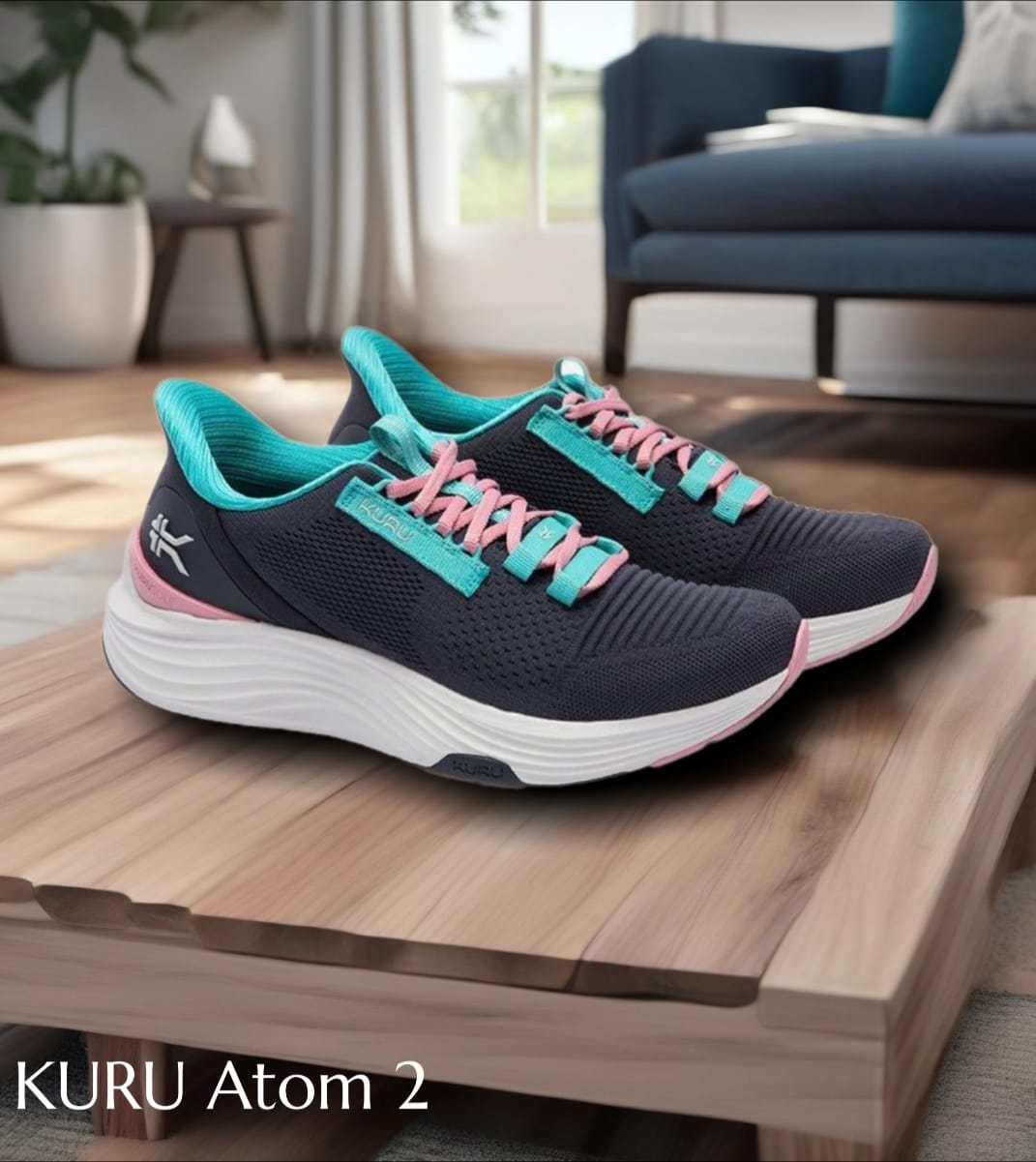
The KURU ATOM 2 is built around heel containment and structured underfoot support. KURU combines its upgraded KURUSOLE heel cradle, KURUCLOUD+ foam, and a contoured ULTIMATE INSOLE with medium, wide, and X-Wide options. That makes it easy to see why the shoe attracts people with heel pain.
It also has meaningful tradeoffs. It is heavy, the official drop is 10 mm, and independent lab measurements found a higher effective drop and less toe space than the “generous toe box” language may suggest. This is a support-first shoe for a specific type of wearer—not a universal pain-relief solution.
Prices Subject to Change
| Current specification | What it means in real life |
|---|---|
| Use | Walking, everyday wear, workouts, and light running according to KURU. |
| Heel system | Upgraded KURUSOLE cradle with KURUCLOUD+ cushioning and ULTIMATE INSOLE. |
| Drop | KURU lists 10 mm; one independent lab measured a higher 13.9 mm on its sample. |
| Weight | Women’s 11.4 oz / 323 g; men’s 13.1 oz / 371 g according to KURU. |
| Women’s widths | Medium B, Wide D, and X-Wide 2E. |
| Men’s widths | Medium D, Wide 2E, and X-Wide 4E. |
| Upper | NOVAKNIT zonal-knit mesh; synthetic and vegan. |
| Cushion height | KURU lists 28 mm heel and 18 mm toe. |
| Price when checked | $169; price can change. |
Independent testing supports the shoe’s secure, durable, support-oriented character but questions the marketing emphasis on energy return and toe-box generosity. Measurements vary by sample and method, so both the official and lab figures are disclosed.
The KURU ATOM 2 may be a weaker choice if you:
Many athletic shoes rely almost entirely on soft foam. The ATOM 2 takes a different approach: it uses a stiff rearfoot cradle and shaped insole to hold the heel while cushioning sits around that structure. For the right foot, that can feel more connected and less sloppy than a cloud-soft neutral trainer.
The key question is not whether KURU calls the technology pain-fighting. It is whether the heel cup, arch contour, toe space, weight, and drop agree with your body. A supportive shape can become a pressure point when it does not match the wearer.
KURU says KURUSOLE flexes with each step to cup the heel. Independent testing found substantial torsional rigidity and a heel-friendly platform, supporting the view that rearfoot structure is a defining feature.
A deep, active cradle can feel wonderful to one person and intrusive to another. It should hold the heel without digging, rubbing, or forcing the arch.
KURU markets the updated foam as springier. Independent lab testing found comfortable softness but low measured energy return. The practical reading is that this is more of a protective walking and standing shoe than a lively speed trainer.
The heavy build reinforces that conclusion. The shoe may feel dependable at an easy pace but tiring for weak legs, foot drop, or faster running.
ATOM 2 has one of KURU’s strongest width ranges, reaching women’s 2E and men’s 4E. That is valuable for full-foot width.
Independent molding found an ordinary forefoot width in the tested medium and limited width and height near the toes. Choose a wide version when needed, but do not assume the X-Wide label automatically solves bunions, hammertoes, edema, or dorsal toe pressure.
KURU lists a 10 mm drop, while RunRepeat measured 13.9 mm on its sample. The heel curve and moderate toe rocker create a heel-biased transition.
That may feel smooth to a heel striker. It may feel too high or forward-driving to someone accustomed to low-drop shoes or someone with balance and toe-clearance problems.
KURU says its stock insole can be removed and a custom orthotic can be used. It also warns that the rounded KURUSOLE heel cup works best with an orthotic that has a rounded underside.
A square-backed orthotic, thick device, or brace may not sit correctly. Test the complete system; do not buy solely because the insole is removable.
KURU recommends wearing its shoes for one to two hours a day for about a week while the support molds to the foot.
Break-in should not mean enduring pinching, burning, numbness, skin changes, or worsening instability. Those are reasons to stop and reassess the fit.
The heel cradle, contoured insole, and rearfoot structure are plausible reasons the ATOM 2 may feel supportive for some people with plantar-fasciitis heel pain. It also offers more width choices than many KURU models.
The shoe does not treat plantar fasciitis. Its high drop, firm structure, arch shape, and toe fit can be wrong for an individual. Footwear should be part of a broader plan rather than the only intervention.
The durable upper, multiple widths, and padded interior may help some users. The limited vertical toe space found in independent testing is a serious reason to inspect the fit carefully when sensation is reduced. Check skin after short wear and never rely on numbness as proof that a pressure point is harmless.
A broad, structured rearfoot and durable outsole may feel more controlled than a very soft shoe. The shoe’s substantial weight can also increase effort, especially late in the day. The right answer depends on whether structure or lightness matters more to the wearer.
The stiff rearfoot may feel secure, but the heavy build, tall heel, and curved geometry can be difficult for a shuffler or someone with weak toe clearance. An X-Wide option does not guarantee AFO depth.
I am not using a numeric score because I did not personally test the ATOM 2 and Rejuva Sole does not have a validated scoring method for this review.
My honest verdict: the ATOM 2 is a serious comparison candidate for someone who wants a heel-first, structured walking shoe and needs one of its three widths. It may be especially appealing when heel containment matters more than low weight or speed.
It is a weaker choice for sensitive toes, hammertoes, a shuffle gait, bulky braces, low-drop preferences, or anyone who finds shaped arch support forceful. The shoe deserves a careful fit trial—not automatic praise because KURU markets pain relief.
At Rejuva Sole, I do not simply recommend popular shoes or repeat a manufacturer’s pain-relief promise.
I evaluate every model using the same Stable Anchor Footwear principles: a steady base, secure heel support, enough room for the toes, controlled cushioning, realistic orthotic compatibility, and comfort that does not ignore balance or mobility. This review clearly separates manufacturer specifications from independent findings and does not claim personal testing that did not happen.
My goal is simple: educate first and recommend second. The right shoe is not the one with the strongest advertising. It is the one that fits your actual feet and helps you move as comfortably and confidently as your circumstances allow.
No. This is a research-based review using current KURU specifications and independent lab findings.
It may feel supportive for some people because of its heel cradle, contoured insole, and structured rearfoot. It does not treat plantar fasciitis, and the arch, drop, and toe fit must match the wearer.
Yes. KURU lists women’s X-Wide as 2E and men’s X-Wide as 4E, in addition to Medium and Wide.
The width range is useful, but independent testing of a medium sample found an ordinary forefoot and limited space near the toes. Choose by actual fit, not marketing language.
KURU allows the stock insole to be removed but says rounded-heel orthotics fit its rounded heel cup best. Test for heel lift, toe crowding, and rocking.
KURU recommends one to two hours a day for about a week. Pinching, burning, numbness, skin irritation, or instability are not acceptable break-in symptoms.
Rejuva Sole provides educational footwear information, not medical advice, diagnosis, treatment, or a guarantee of pain relief or fall prevention. Footwear may support comfort, but the 2023 heel-pain clinical practice guideline does not treat an orthosis as a stand-alone short-term solution. Stop using a shoe that causes pain, numbness, skin irritation, new pressure, or instability, and ask a qualified healthcare professional about persistent heel pain, circulation problems, ulcers, fall risk, braces, orthotics, or prescribed footwear.