Cadense Original Adaptive Shoes Review
Can Glide-to-Grip Technology Make Walking Easier?
Rejuva Sole™ | Research-Based Footwear Review
An in-depth look at Cadense adaptive sneakers for foot drop, neuropathy, stroke recovery, arthritis, and other mobility challenges.
Affiliate Disclosure: Rejuva Sole may earn a commission from qualifying purchases at no additional cost to you. This is an independent, research-based review, not a personal wear test.
When Walking Becomes Something You Have to Think About
For many people living with chronic pain, neurological conditions, or mobility limitations, walking is no longer automatic.
A foot catches on the carpet. A toe drags across the sidewalk. A doorway threshold becomes an obstacle. Even a short walk across the living room can require concentration.
Most footwear companies focus on cushioning, arch support, or energy return.
Cadense approaches walking from another direction:
What if a shoe could reduce the resistance that makes a dragging foot catch on the ground?
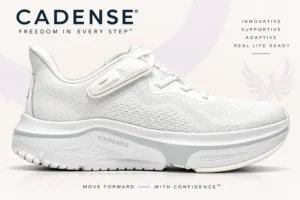
The Cadense Original Adaptive Sneaker uses patented Variable Friction Technology to address that challenge.
It’s an intriguing approach, particularly for people who shuffle or struggle to lift their feet.
But its unusual sole design also raises important questions about traction, balance, fit, and individual safety.
At Rejuva Sole, we believe supportive footwear should be judged by how well it meets a person’s needs, not simply by how innovative it sounds.
How Cadense’s Technology Works
Unlike a conventional sneaker, which generally tries to maintain traction against the walking surface, Cadense intentionally combines low-friction and high-friction areas.
The outsole uses three key elements:
- Low-Friction Nylon Pucks: Designed to help the shoe slide forward when the foot drags or encounters resistance.
- Articulated Foam Rocker: Compresses under weight, changing how the outsole contacts the ground.
- High-Friction Rubber: Designed to engage during weight-bearing, helping the wearer stop and push off.
The intended result is a shoe that glides when a foot needs help moving forward and grips when the wearer places weight on it.
That distinction matters.
Cadense isn’t simply a slippery shoe. It is engineered to change its friction behavior during different phases of walking.
However, the transition between sliding and gripping depends on the wearer, their gait, and the surface beneath them.
It should not be assumed to work identically for everyone.
Learn More:
https://cadense.com/pages/how-cadense-shoes-work
Cadense Original: Features and Specifications
Primary Purpose: Walking difficulties and reduced foot clearance
Outsole: Variable-friction nylon and rubber
Midsole: Articulated rocker construction
Closure: Adjustable hook-and-loop strap
Toe Box: Generously spaced
Available Widths: Regular and wide
Sole Height: Approximately 1.5 inches
Heel-to-Toe Drop: Approximately 3/8 inch
Weight: Approximately 13 ounces, based on men’s size 9
AFO Accommodation: Possible with certain braces, depending on fit
Specifications are based on manufacturer information and should be verified for the specific model and size before purchasing.
How Cadense Fits Rejuva Sole’s Six Conditions
Every person walks differently.
A shoe that helps one individual may be unsuitable for another, even when both people share the same diagnosis.
Here is how Cadense’s technology relates to Rejuva Sole’s six condition pathways.
1. Stroke, Foot Drop & Balance
Rejuva Sole Assessment: Strongest Design Match
People recovering from a stroke may experience reduced ankle control, foot drop, or difficulty advancing one leg.
When the toes fail to clear the ground, the foot may catch on carpeting, uneven pavement, or other obstacles.
Cadense’s low-friction elements are specifically intended to reduce catching during forward movement.
This is one of the clearest reasons to consider the shoe.
However, stroke-related balance impairment varies greatly.
Some people require an ankle-foot orthosis (AFO), assistive walking equipment, or individualized gait training.
Cadense does not replace these interventions.
Our Recommendation:
Worth discussing with a physical therapist for someone experiencing toe drag.
A supervised trial is especially important for individuals with a history of falls or significant balance impairment.
2. Neuropathy & Neurological Conditions
Rejuva Sole Assessment: Potentially Suitable for Toe Drag
Neuropathy can affect sensation, muscle control, and awareness of foot position.
When muscle weakness causes toe dragging, Cadense’s sliding elements may offer a mechanical advantage.
The same reasoning may apply to selected people living with:
- Multiple sclerosis (MS)
- Parkinson’s disease
- Peripheral neuropathy
- Certain neuromuscular disorders
- Other neurological conditions affecting foot clearance
However, neuropathy without gait difficulty is a different situation.
People with significant sensory loss must also consider pressure, rubbing, shoe fit, and skin protection.
A shoe that changes friction against the ground does not necessarily provide the protective features needed for every neuropathic foot.
Our Recommendation:
A meaningful option to investigate for certain gait problems, but not automatically a therapeutic shoe for everyone with neuropathy.
People with reduced sensation should inspect their feet and footwear regularly and consult their healthcare provider about appropriate protection.
3. Arthritis, Bunions & Foot Pain
Rejuva Sole Assessment: Conditional Suitability
Arthritis can make ordinary walking uncomfortable, especially when the feet and ankles are affected.
Cadense offers several potentially helpful features.
Its roomy toe box may appeal to people with bunions, swollen joints, or rheumatoid arthritis.
The adjustable closure may also make putting on shoes easier for people with painful or stiff hands.
The rocker construction changes how the foot moves through each step, which could affect movement at painful joints.
However, we cannot assume this will reduce arthritis pain.
For someone with rheumatoid arthritis and additional gait difficulties, Cadense may deserve consideration.
For someone whose primary problem is joint pain without toe dragging, a conventional supportive shoe may be a better choice.
Our Recommendation:
Consider Cadense when arthritis coexists with shuffling, toe drag, or another relevant walking difficulty.
We would not recommend it solely as a treatment for arthritis pain.
4. Obesity & Bariatric Mobility
Rejuva Sole Assessment: Insufficient Evidence for Routine Recommendation
People carrying greater body weight may need footwear that offers dependable stability, appropriate cushioning, sufficient width, and durable construction.
Cadense’s variable-friction mechanism may be relevant when someone also experiences shuffling or reduced foot clearance.
However, we need more information about:
- Long-term cushioning performance
- Stability under different body weights
- Outsole durability
- Fit for wider feet
- How the sliding mechanism behaves under different walking patterns
Our Recommendation:
Cadense is not a primary recommendation based on body weight alone.
Its technology may be worth investigating when a person also has a walking difficulty that the shoe is designed to address.
5. Plantar Fasciitis
Rejuva Sole Assessment: Not a Primary Recommendation
Plantar fasciitis often requires attention to heel comfort, plantar fascia loading, arch support, and appropriate walking mechanics.
Cadense includes cushioning and rocker features, but its signature technology targets foot advancement rather than plantar heel pain.
There is insufficient evidence to recommend Cadense specifically for plantar fasciitis relief.
Our Recommendation:
Consider Cadense only when plantar fasciitis coexists with a walking difficulty that its variable-friction technology may address.
For plantar fasciitis alone, we would investigate footwear with more directly relevant support characteristics.
6. Chronic Pain: Back, Hip, Knee & Foot
Rejuva Sole Assessment: Potential Benefit Depends on Gait
Chronic pain can change the way a person walks.
Some people develop shorter steps, guarded movements, or compensatory walking patterns.
If toe catching contributes to an inefficient gait, Cadense’s technology may be worth exploring.
However, there is insufficient evidence to claim that Cadense directly relieves chronic back, hip, knee, or generalized foot pain.
Our Recommendation:
Consider Cadense as a specialized mobility option when a relevant gait problem is present.
We would not recommend it as an everyday chronic-pain solution without additional evidence.
What Does the Research Actually Show?
Cadense traces its technology to gait-rehabilitation research associated with MIT and the University of California, Santa Barbara.
The company’s research overview describes early prototype testing, user evaluations, and research involving people with stroke-related walking difficulties.
Cadense also reports a substantial reduction in self-reported injurious falls in a survey involving 705 respondents.
That finding requires careful interpretation.
An observational, self-reported comparison cannot establish that the shoes themselves prevented falls.
People’s activity levels, walking environments, health conditions, and other factors may influence their reported experiences.
Early testing and positive user experiences are encouraging.
However, they do not establish that Cadense is superior to conventional footwear, prescribed orthoses, or physical therapy for every condition.
At the time of this review, we have not established definitive results from a large independent randomized trial demonstrating reduced falls or long-term clinical improvement with the commercial Cadense Original.
Research Resources:
Cadense Research:
https://cadense.com/pages/research
Cadense Information for Medical Professionals:
https://cadense.com/en-ca/pages/instructions-medical-professionals
What Concerns Us About Cadense?
Cadense’s greatest innovation is also the reason it deserves careful consideration.
Reduced friction is not universally desirable.
Someone with severe balance impairment, difficulty controlling weight shifts, or unpredictable movements may respond differently to the sliding mechanism.
We would be particularly cautious about first using these shoes on:
- Stairs
- Wet floors
- Ramps
- Loose rugs
- Uneven surfaces
- Unfamiliar terrain
Other considerations include:
Sole Height:
The approximately 1.5-inch sole changes the wearer’s position relative to the ground.
Adjustment Period:
The unusual friction mechanism may require time and supervised practice.
Individual Gait Patterns:
Not everyone will experience the same sliding and gripping behavior.
Fit and Accommodation:
People with significant swelling, deformities, or orthotic requirements need careful fitting.
Long-Term Wear:
The durability and wear characteristics of the low-friction components deserve consideration.
Someone using a walker, cane, or ankle-foot orthosis should have their footwear evaluated alongside that equipment.
For anyone at high risk of falling, the first trial should be supervised by a qualified rehabilitation professional.
Fit, Width & Accessibility
Cadense offers regular and wide options.
However, people requiring extra-wide or exceptionally deep footwear may need a more accommodating design.
The adjustable hook-and-loop closure is a welcome feature for individuals who struggle with traditional shoelaces.
This may be particularly helpful for people experiencing:
- Limited hand dexterity
- Painful finger joints
- Difficulty bending
- Reduced coordination
- One-sided weakness
Cadense also offers a separate AFO-specific model designed to accommodate certain ankle-foot orthoses.
Readers using bulky AFOs should investigate that model rather than assuming the Original will fit.
Always consult the model-specific sizing chart before ordering.
Price & Purchasing Considerations
Cadense is a significant footwear investment, especially for readers living on a fixed income.
Before purchasing, we recommend checking:
- Current pricing
- Available widths
- Size availability
- Return eligibility
- Return shipping or handling fees
- Trial-period requirements
- Conditions relating to shoe wear
Cadense advertises a trial period, but specific refund terms and promotional conditions may vary.
Always read the return policy associated with your purchase.
Shop Cadense Original: Men’s & Women’s
Choose your preferred size, width, and color at Cadense. Check current pricing and return terms before ordering.


Who Should Consider Cadense?
Cadense may be worth investigating if you:
- Experience toe dragging during walking
- Have difficulty clearing your foot from the ground
- Shuffle because of a neurological condition
- Have stroke-related walking difficulties
- Need footwear that is easier to put on
- Have been advised by a rehabilitation professional to explore adaptive footwear
Who Should Be Especially Cautious?
Additional professional guidance is important if you:
- Have significant balance impairment
- Experience frequent falls
- Have unpredictable foot placement
- Have substantial loss of protective sensation
- Require specialized orthotic accommodation
- Have significant foot deformities
- Depend on consistent traction for safe mobility
These concerns do not automatically rule out Cadense.
They mean the shoe should be evaluated carefully for your individual needs.
Rejuva Sole’s Final Assessment
The Cadense Original is one of the more unusual adaptive footwear designs we’ve examined.
Rather than simply adding more cushioning, it attempts to address a specific walking problem.
Its most compelling potential benefit is for people who struggle with toe catching, shuffling, or reduced foot clearance.
For those readers, Cadense offers an interesting and thoughtfully engineered concept worth exploring with a rehabilitation professional.
For readers whose primary concerns are plantar fasciitis, generalized arthritis pain, or high-capacity cushioning, we would recommend considering more conventional supportive footwear first.
Our Verdict:
Cadense is a promising specialized mobility shoe, not a universal solution for chronic pain or balance problems.
Its design deserves attention, but clinical evidence and individual safety must guide purchasing decisions.
At Rejuva Sole, we believe the right shoe is the one that supports your particular walking needs, fits your feet, and helps you move with appropriate safety and confidence.
Rise Above the Ache™
Additional Reading Resources
Cadense Research and Development
https://cadense.com/pages/research
Understanding Variable Friction Technology
https://cadense.com/pages/how-cadense-shoes-work
CDC: Diabetes and Your Feet
https://www.cdc.gov/diabetes/diabetes-complications/diabetes-and-your-feet.html
Arthritis Foundation: Footwear Guidance
https://www.arthritis.org/
Royal National Orthopaedic Hospital: AFO Patient Information
https://www.rnoh.nhs.uk/
Medical Disclaimer
Rejuva Sole provides footwear education, not medical advice.
We are not medical professionals, and our reviews should not replace individualized medical assessment.
People with foot drop, neurological conditions, significant balance difficulties, loss of protective sensation, or prescribed orthoses should consult a qualified healthcare professional before changing footwear.
Product suitability depends on individual anatomy, mobility, health conditions, and walking environments.