REJUVA SOLE™
Rise Above the Ache™
Rise Above the Ache™
Affiliate disclosure: As an Amazon Associate, I earn from qualifying purchases. If you buy through the product link on this page, I may earn a commission at no additional cost to you. That never changes what I say about a shoe. You can read my full affiliate disclosure here.
How this review was created: I did not personally test the New Balance Fresh Foam X 840v1. This is a research-based review built from New Balance’s published specifications, the original Rejuva Sole analysis, and a careful look at fit, cushioning, support, and the needs of readers living with pain or mobility challenges. I will not pretend that research is the same as wearing the shoe.
My short take: This is an extra-soft, neutral shoe—not a stability or motion-control shoe. Its Fresh Foam X cushioning and lace-up mesh upper may make it a comfortable all-day or walking option for the right person. The honest gray area is that soft cushioning can feel soothing to one reader and less predictable to another. If you need firm guidance, extra depth, or room for a bulky brace, the 840v1 may not be your best match.
Availability note: As of August 20, 2026, the official U.S. and Canadian model pages redirect to newer running-shoe collections, and the 840v1 is not in New Balance’s current Fresh Foam X catalog. I would treat it as a legacy or remaining-stock model. Sizes, colors, and widths can be inconsistent, so check the exact listing and return policy before ordering.
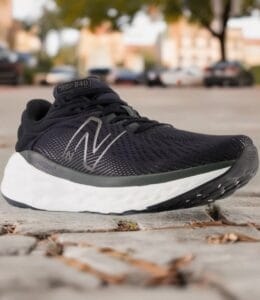
The strongest part of the original review was its focus on cushioning, fit, and everyday comfort. Those are still the right things to examine, but a few important claims needed tightening. New Balance classified the 840v1 as neutral with extra-soft cushioning. The company’s archived product information listed a Fresh Foam X midsole, a synthetic mesh upper with no-sew overlays, no-sew midfoot support, a molded heel, adjustable laces, and an approximate 4 mm heel-to-toe drop.
One detail matters more than the marketing language: cushioning is not the same as stability. The no-sew midfoot support and molded heel may help the upper hold your foot, but they do not turn the 840v1 into a motion-control shoe. If your clinician has recommended a stability shoe, a brace-compatible shoe, or a therapeutic extra-depth shoe, do not assume this neutral model is an equivalent substitute.
Comfort is where the original Rejuva Sole review believed the 840v1 would shine, and the official specifications support the reason for that optimism: New Balance described the ride as extra soft. Fresh Foam X gives this shoe the plush underfoot feel many people want for errands, everyday walking, or long periods on their feet.
Still, I want to be careful with the word “comfort.” A softer midsole can reduce the harsh feeling of impact, but it does not prove that the shoe will relieve foot, knee, hip, or back pain. It also does not guarantee that the shoe will stay comfortable for your full day. Your foot shape, gait, walking surface, and tolerance for soft foam all matter.
The mesh upper is a practical plus. New Balance designed it for a breathable, lightweight feel, so I would expect it to feel less hot and rigid than a heavy leather walking shoe. It is not waterproof, though, and people who prefer a very open, minimally padded upper may still find any conventional running-shoe build warmer or bulkier than they like.
The original review praised a broad, confidence-inspiring platform. That is a useful visual observation, but I would not turn it into a promise about balance or fall prevention. New Balance itself labeled the shoe neutral. A broad-looking sole can feel planted, while the extra-soft foam can create the opposite sensation for a person who needs a firm, very predictable base. Both reactions are possible.
The 840v1 makes the most sense for someone who is already comfortable in a neutral shoe and wants cushioning without a posted medial support system. It is a weaker match if you know you need motion control, strong pronation guidance, a rigid rocker, or a firm platform. The approximate 4 mm drop is also lower than many traditional walking shoes, so anyone accustomed to a higher heel-to-toe offset may want a gradual indoor trial rather than wearing it for a full day immediately.
The archived official women’s listing I found offered Standard (B), Wide (D), and X-Wide (2E). Those are women’s-version widths only; they are not evidence of the men’s range. I could not independently confirm the exact historical width range for the men’s 840v1 from a model-specific official listing. Because the men’s product page now redirects, check the width on the exact remaining-stock men’s SKU—not a general New Balance width chart or the women’s listing.
A wide label also does not tell you the shoe’s depth, toe-box shape, or heel volume. That is especially important for swelling, bunions, hammertoes, orthotics, or braces. The lace closure gives you some adjustment across the instep, but this is not marketed as an extra-depth therapeutic shoe.
The original review called the shoe orthotic-friendly because of a removable insole. I could not confirm removable-insole wording on the official product information that remains available, so I am not repeating that as a guarantee. If you use a custom orthotic, confirm that the stock liner can be removed and that the shoe has enough depth and heel security for your device. If you use an AFO or another bulky brace, this standard lace-up running shoe may simply be too shallow.
I could not independently verify an official weight for the men’s 840v1, so I am not using the women’s published weight as a proxy. Without a verified men’s figure or a hands-on test, I would not call the men’s shoe lightweight or heavy. A cushioned shoe can still feel more substantial underfoot than a flexible, low-profile sneaker. I also did not find reliable flex-testing data for this model, so I would not call it either unusually flexible or unusually stiff without handling it.
For everyday use, the practical tradeoff is straightforward: the 840v1 gives you a lot of softness without the technical guidance of a stability shoe. That may be exactly the middle ground some walkers want. For others—especially those who feel unsteady on compliant foam—the same formula may be a reason to pass.
The older review recommended this shoe for foot, knee, hip, and back pain and gave it a “best for chronic pain” award. I removed those promises. A cushioned shoe may feel more comfortable, but the specifications do not establish that the 840v1 treats pain, arthritis, neuropathy, or any other condition.
For readers with reduced sensation, pressure spots can be easy to miss. The National Institute of Diabetes and Digestive and Kidney Diseases advises wearing shoes that fit well, checking inside them, and examining your feet for redness, blisters, or sores. If you have a history of ulcers, significant deformity, Charcot changes, or a prescribed footwear plan, work with your healthcare or foot-care team rather than relying on a general running-shoe review.
You may also find my guides to neuropathy and footwear and choosing therapeutic shoes helpful for understanding why fit, depth, pressure, and stability matter as much as cushioning.
It can be—if the neutral, extra-soft design fits your needs and the seller gives you a fair return window. I would not pay a premium simply because the model is becoming harder to find. Remaining-stock pricing can move in both directions, and future replacement in the same size and width may be difficult.
Also check the name carefully. The Fresh Foam X 840v1 reviewed here is not the same product as the newer Fresh Foam X 840F slip-resistant walking shoe. Similar numbers do not mean identical support, fit, outsole, or use.
No. This review is based on product research and Rejuva Sole’s careful evaluation of the published design and specifications. I do not claim hands-on use when I have not personally tested a shoe.
No. New Balance classified it as a neutral shoe. Its soft cushioning and upper structure should not be confused with a motion-control or stability system.
The model-specific official pages now redirect, and the 840v1 is absent from the current Fresh Foam X catalog. I treat it as a legacy or remaining-stock model, although some retailers may still have sizes available.
For the women’s version, the archived official listing showed B, D, and 2E. I could not independently confirm the exact historical width range for the men’s 840v1 from a model-specific official listing, so those women’s widths should not be applied to the men’s shoe. Check the width shown on the exact remaining-stock men’s SKU.
Possibly for some low-profile orthotics, but compatibility is not guaranteed. Confirm that the liner can be removed and that there is enough depth and heel security. A bulky orthotic or AFO may require a true extra-depth shoe.
No shoe can promise that result. The 840v1 may feel comfortable to someone who likes soft cushioning, but it does not treat chronic pain, neuropathy, arthritis, diabetes, or balance problems.
The recovered review was right to focus on the 840v1’s cushioning and everyday appeal. Where it went too far was turning those features into near-universal claims about stability and pain relief. My corrected view is more measured: this is a soft, neutral shoe that may work very well for a walker who enjoys cushioning and does not need corrective guidance.
I would avoid it if soft foam makes you feel unsteady, if you need verified extra depth, or if a healthcare professional has recommended a specific stability or therapeutic design. And because it is now a legacy model, I would only buy from a seller that clearly identifies the exact size and width and allows an indoor fit trial.
Finding your “Sole Mate” sometimes takes more than one pair, and that is perfectly okay. The right shoe is the one that matches your feet and your real needs—not the one with the biggest promises.
Try new shoes indoors on a clean surface while the return window is open. Check toe room, heel movement, pressure points, traction, and stability for more than a few minutes. Stop if a shoe causes pain, numbness, skin irritation, new pressure, or a feeling of instability.
Medical note: I am not a physician, nurse, podiatrist, or other medical professional. Rejuva Sole provides educational information based on lived experience and product research. It is not medical advice, diagnosis, or treatment. Ask a qualified healthcare professional about symptoms, circulation problems, fall risk, braces, orthotics, or footwear needs specific to you.