REJUVA SOLE™
Rise Above the Ache™
Rise Above the Ache™
Affiliate disclosure: As an Amazon Associate, I earn from qualifying purchases. If you buy through a link on this page, I may earn a commission at no additional cost to you. Affiliate relationships do not change my conclusions.
How this review was created: I have not personally wear-tested this model. This is my independent, research-based review after spending hours comparing manufacturer and retailer information, design features, sizing and width details, and the practical needs of Rejuva Sole readers.
My short take: The Dr. Comfort Women’s Annie X is worth comparing if your priorities include extra-depth construction, closure, width and support. It is not a medical device, fit is individual, and I would only keep it after a careful indoor trial.
Important limitation: Extra depth may help with foot volume or orthotics, but neuropathy or swelling requires careful pressure and skin checks.
The “X” matters. The Dr. Comfort Annie X is not simply the regular Annie in another color. It is a double-depth shoe, built ¼ inch deeper than regular Dr. Comfort shoes to provide more internal volume.
That extra depth is useful for women who need room for:
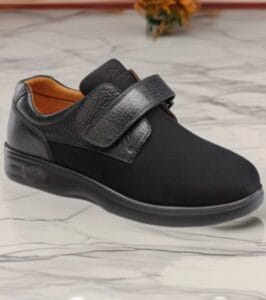
The upper combines stretch Lycra® with leather trim. Instead of forcing a swollen foot into a rigid leather shoe, the material gives the foot more forgiving space while the heel and sole still provide structure.
Affiliate Disclosure: As an Amazon Associate I earn from qualifying purchases
The Annie X is available in widths up to EEEE, which is the main reason it belongs in our Obesity, Swollen Feet & XX-Wide Widths category.
Its hook-and-loop closure opens wide and allows the fit to be adjusted when swelling changes. That is especially helpful when a shoe fits differently in the morning than it does later in the day.
The removable insole is another important feature. You can remove it to make more room for a prescribed orthotic. The included insole also has supportive cushioning, including gel pods in the heel and forefoot.
This is not a shoe to order by appearance alone. If you use an AFO, custom orthotic, or have severe swelling, measure your feet later in the day and follow the manufacturer’s size guidance. A podiatrist, pedorthist, or qualified shoe fitter can help if you are unsure.
The Annie X is not a running shoe, but it is more supportive than a soft house shoe or a generic stretch sneaker.
Key stability features include:
For women who feel “wobbly” in soft, unsupportive shoes, the structured heel and wider base can provide a steadier starting point. Still, no shoe can guarantee fall prevention. If balance is a major concern, discuss footwear with your medical provider or physical therapist.
Choose the Dr. Comfort Annie X if your priority is accommodation.
It is especially worth considering when standard wide shoes still press on the toes, feel too shallow over the top of the foot, or cannot hold an orthotic comfortably.
This shoe may be a strong match for:
The Annie X is purpose-built, and that comes with tradeoffs.
It may not be the right choice if you need:
The stretch upper is helpful for swelling, but it is not a substitute for choosing the correct width. A shoe that is too loose can also reduce stability.
The New Balance WW928v3 is our women’s top overall pick for firm walking stability and motion control. The Dr. Comfort Annie X has a different job.
Choose the New Balance WW928v3 if you need a structured walking shoe and maximum everyday stability.
Choose the Dr. Comfort Annie X if you need more depth, more room for swelling, or accommodation for orthotics and braces.
In short: the New Balance is the stronger stability walker; the Annie X is the stronger accommodation shoe.
The Dr. Comfort Annie X earns its place because it solves a problem many standard shoes do not: finding enough safe, adjustable room without giving up all structure.
For women with severe swelling, high-volume feet, custom orthotics, or brace needs, it can be far more practical than a standard wide sneaker. It is not the best choice for every woman, but it is one of the best women’s options when extra depth is the real priority.
Check current price, available widths, and colors before ordering.
I reviewed the features described for the Dr. Comfort Women’s Annie X with the questions that matter most to me as someone living with neuropathy, chronic pain, and mobility limitations: Is the base likely to feel predictable? Is the heel secure? Are there useful width or closure options? Could the cushioning or geometry create a tradeoff for balance? Product details and availability can change, so verify the exact model, size, and return policy before buying.
No. This review is based on my independent product research and my experience evaluating footwear features for people with pain, neuropathy, balance concerns, swelling, and mobility limitations. I do not claim hands-on use when I have not personally tested a shoe.
No. Shoes may affect comfort, fit, or stability, but they do not diagnose, cure, or treat medical conditions. Persistent pain, numbness, swelling, skin changes, or fall risk should be discussed with a qualified healthcare professional.
Try it indoors on a clean surface while the return window is open. Check toe room, heel movement, pressure points, traction, and stability for more than a few minutes. If you use an orthotic or brace, test it with the shoe rather than relying on a width label alone.
Based on my research, the Dr. Comfort Women’s Annie X deserves consideration for shoppers focused on extra-depth construction, closure, width and support. I would not call it universally “best,” and I would not promise medical relief. The honest decision comes down to whether its design matches your foot shape, gait, support needs, and ability to return it if the fit is wrong.
Try new shoes indoors while the return window is open. Stop if a shoe causes pain, numbness, skin irritation, new pressure, or a feeling of instability.
I am not a physician, nurse, podiatrist, or other medical professional. Rejuva Sole provides educational information based on my lived experience and hours of product research. It is not medical advice, diagnosis, or treatment. Ask a qualified healthcare professional about symptoms, fall risk, circulation problems, braces, orthotics, or footwear needs specific to you.
Affiliate reminder: I may earn a commission from qualifying purchases made through links on this page, at no additional cost to you. I do not let commissions determine what I say about a product.